

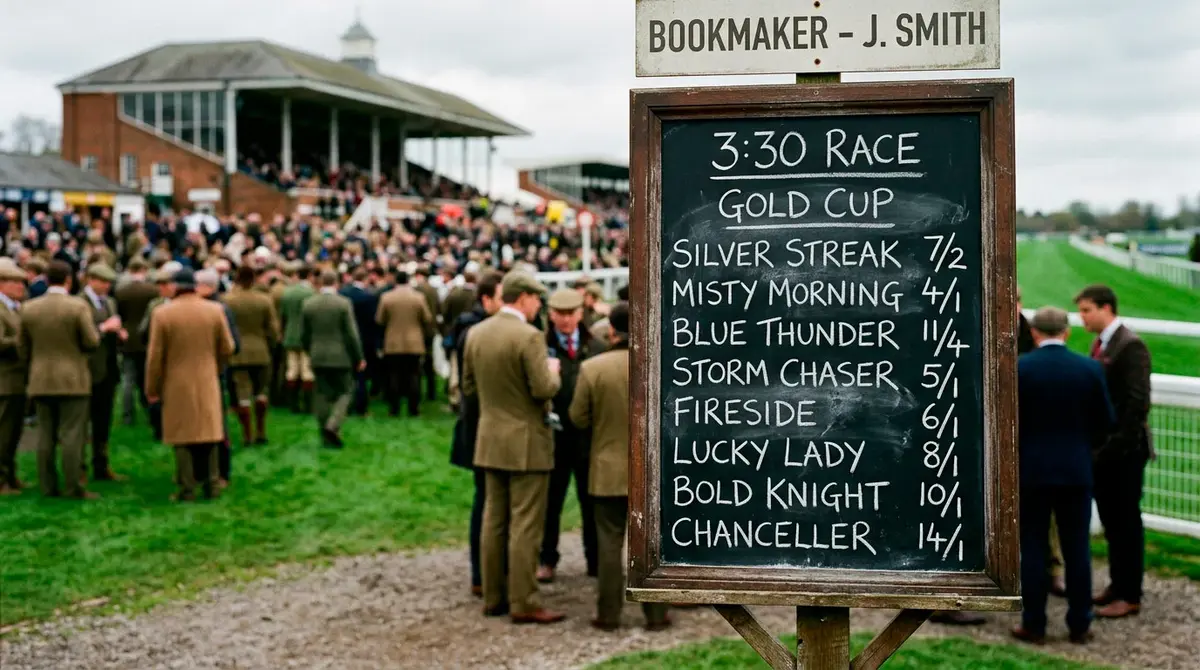
Why a fraction on a board can still beat a decimal on a screen
The first time someone handed me a betting slip at Sandown, I was nineteen and convinced I had a foolproof system. The bookmaker chalked up 11/4 on his board, I wrote 3.75 on the back of my card because that was how the maths site had explained it, and when I came to collect I got back less than I expected. Nothing had gone wrong. I had just never properly understood what a price actually represented — and the gap between what I thought 11/4 meant and what it really meant cost me a few pints’ worth.
Nine years on, and having watched a lot of clever people lose money for the same reason, I can tell you that the single biggest leak in a new punter’s bankroll is not picking the wrong horse. It is misreading the price. Not the horse. The price. Fractions hide things that decimals expose, decimals blur things that fractions sharpen, and the Starting Price is a completely different animal from both. In UK flat racing, favourites win roughly thirty-three percent of races, second favourites land nineteen and a half percent, and third favourites cluster between twelve and fifteen percent — numbers I will keep coming back to, because every conversation about odds eventually crashes into the question of whether the market actually knows what it is doing.
This article is the long answer. By the end of it you will read a board, a screen and a racecard with the same confidence, and you will know exactly where your money disappears between the quoted price and the cash you collect. Buckle in. We are going to do the maths properly.
How UK odds are quoted and why three formats coexist
Walk into any British betting shop on a Saturday afternoon and you will see the same price expressed three different ways within about two metres of each other. The overhead screen shows 7/2. The tablet on the counter shows 4.5. The on-course pitch on the live feed shows 7/2 with an SP indicator next to it. One horse, three numbers, none of them wrong. The shop staff will be reading the board, the algo traders on the exchange will be reading decimals, and the clerk of the scales on the racecourse is working off yet another set of conventions entirely.
The UK retains fractional odds for the same reason the Royal Mail still sends Christmas stamps with horses on them. Tradition, yes, but also utility. A fraction tells you profit versus stake in one glance. 7/2 means you risk two to win seven. You do not need to subtract anything. On a loud course, with rain on the card and two minutes to the off, you want a number that answers one question — how much do I stand to make — and a fraction does that job without the detour through total return.
Decimals arrived with the exchanges and the continental operators. They show total return per unit staked. 7/2 becomes 4.5, which means a one-pound stake returns four pounds fifty total — three pounds fifty profit plus the original pound back. Nothing magic, just a different presentation of the same underlying proposition. Where decimals win is in comparison. Stack 4.5 against 4.4 against 4.6 and you instantly see which is best. Try doing that with 7/2, 17/5 and 18/5 in your head while a race is loading.
The third format, still lurking in corners of the American press and occasionally creeping into UK coverage of international racing, is moneyline. A 7/2 chance becomes +350. Nobody in British racing quotes prices this way at the coal face, but if you ever bet on the Breeders’ Cup through a US-facing window you will meet it, and the conversion is worth knowing. A plus number is how much you win on a hundred-unit stake. A minus number is how much you must stake to win a hundred. 7/2 is +350 because three hundred and fifty profit per hundred staked.
Why does this three-format mess persist? Because the UK racing economy is schizophrenic by design. Retail shops cater to casual punters who grew up on fractions. Online books cater to younger customers who think in decimals. Exchanges cater to traders who want decimals to two or three places. And the racecourse still runs on chalk because chalk works even when the wifi does not. Remote betting produced seven hundred and sixty-six million pounds of gross gambling yield on horse racing in the financial year to March 2025, retail produced two and a half billion across all sports, and the two audiences barely overlap in how they read a price.
Reading fractional odds without converting in your head
There is a trick I teach every new punter who will sit still long enough, and it is this: stop converting. If you are trying to translate 11/4 into 3.75 into implied probability into expected value every time you glance at a board, you will exhaust yourself before the first race has gone off. Instead, learn to read fractions on their own terms.
The left number is what you win. The right number is what you stake. Full stop. Horse quoted at 5/1 — risk one, win five. At 11/4 — risk four, win eleven. At 2/1 on, which is the British way of writing 1/2, you risk two to win one. When the left number is bigger than the right, the horse is against — a longer shot than evens. When the right number is bigger, the horse is on — shorter than evens. Evens itself is the spine of the board. Everything a bookmaker quotes is measured in relation to that hinge.
Where new punters fall over is the non-standard denominators. 5/2, 9/4, 11/8, 13/8, 15/8, 11/10, 21/20. These are not arbitrary. They are the rungs between the major price points, and they exist because demand moves the market in small increments. 11/10 sits a shade above evens. 5/4 is a shade above that. 11/8 is a shade above 5/4. The board climbs in halves and quarters and eighths the same way a ruler climbs in millimetres. Once you see the ladder — evens, 11/10, 5/4, 11/8, 6/4, 13/8, 7/4, 15/8, 2/1, 9/4, 5/2, 11/4, 3/1 — the chalked prices stop looking random and start looking like a staircase.
One genuine trap. 11/10 and 21/20 are not the same price, even though they look mathematically near-identical. 11/10 is a fraction chosen because it reads cleanly. 21/20 does exist in practice on some exchanges, and it sits a whisker tighter than 11/10. The difference is tiny, but on a thousand-pound stake over a long punting year it is the difference between a nice dinner and a noisy argument with your partner about priorities. Always check which one you are taking.
When you are three weeks into learning to read fractions, you will notice you stop translating. You will glance at 9/2 and simply know it is a middling outsider, fair value if you fancy the horse, skinny if you do not. That moment is when the game opens up, because you are no longer spending half your mental energy on the arithmetic.
Converting fractional to decimal and why you should do it once, not always
Converting is not hard. Divide the left number by the right number, add one. 11/4 becomes 11 divided by 4 which is 2.75, plus 1 which is 3.75. 7/2 becomes 3.5, plus 1, so 4.5. Evens becomes 1 plus 1, so 2.0. The decimal is the total return per unit staked, where the fraction was profit per unit staked, and the plus-one simply adds the returned stake.
The reason I say do it once, not always, is that the moment you start comparing prices across operators you should be in decimal and stay there. Three operators quoting 11/4, 3.8 and 11/4 — which is best? In fractions you are guessing. In decimals, 3.75, 3.8, 3.75, you see instantly that the middle one is slightly bigger. A five-per-cent overlay here, a two-per-cent overlay there. Over a year of betting, those are not margins of rounding. Those are your rent.
The reverse conversion matters less often, but it helps when you are reading an exchange screen and want to sanity-check against a board. Take the decimal, subtract one, then express the remainder as a fraction. 3.75 minus 1 is 2.75, which is 275/100, which simplifies to 11/4. 2.5 minus 1 is 1.5, which is 3/2, which is 6/4 on a British board, normally written 6/4. 1.5 minus 1 is 0.5, which is 1/2, written by a UK bookmaker as 2/1 on. This is the one place where the British insistence on writing odds-on prices backwards — 2/1 on rather than 1/2 — catches out new punters who have learned decimals first.
Keep a cheat table in your head for the twelve or fifteen most common prices. Evens is 2.0, 6/4 is 2.5, 2/1 is 3.0, 5/2 is 3.5, 3/1 is 4.0, 7/2 is 4.5, 4/1 is 5.0, 9/2 is 5.5, 5/1 is 6.0, 6/1 is 7.0, 8/1 is 9.0, 10/1 is 11.0, 20/1 is 21.0. That ladder covers ninety percent of the prices you will ever need to compare quickly.
Implied probability, overround and the margin you cannot see
Here is the thing every shop explainer glosses over. A price is not just a payout. A price is a probability — or rather, the bookmaker’s expression of a probability, plus the bookmaker’s margin, plus a bit of human error. Knowing how to extract the implied probability is where casual punters become thinking punters.
To get the implied probability from a decimal, divide one by the decimal. A 2.0 chance implies one divided by two, which is 0.5, so fifty percent. A 4.0 chance implies twenty-five percent. A 11.0 chance implies about nine percent. From a fraction, the formula is the denominator divided by the sum of numerator and denominator. 10/1 gives you 1 divided by 11, which is about nine percent. 3/1 gives you 1 divided by 4, twenty-five percent. Same answer, different road.
Now the interesting part. Add up the implied probabilities of every horse in a race. In a fair world, the total is exactly one hundred percent. Somebody wins, and the sum of each horse’s chance of being that somebody must be the whole. In the real world, you will find the total is one hundred and eight, one hundred and twelve, sometimes one hundred and twenty percent. That excess is the overround. It is the bookmaker’s built-in margin — the cushion that pays for the chalk, the shop rent and the Porsche.
A ten-runner race priced at one hundred and ten percent has a ten-percent overround. For every pound bet across every horse in perfect proportion, the book returns about ninety-one pence. Nine pence per pound is the edge. On a twenty-runner handicap priced at one hundred and twenty-five percent, the overround is twenty-five percent, and the book returns eighty pence per pound. This is why high-field handicaps are priced so much wider than a six-horse Group One. The bookmaker is not charging you more for the same product. They are pricing in the genuine uncertainty of a big field, and building a bigger cushion against their own inability to model it.
Exchanges run lower overrounds because they are marketplaces, not shops. The commission is charged separately on winnings, normally at between two and five percent. Traditional books run higher overrounds because they absorb volatility from every direction — accumulators, early-morning markets, cash-out closures. The number I want you to carry out of this section is simple. If you can compute overround in your head for a given market, you know instantly whether the price you are about to take is generous, average or dreadful compared to the fair value.
The Starting Price and what the betting ring actually decides
Six years ago, on a damp Wednesday at Sedgefield, I had ten pounds on a horse at 12/1 taken the night before. By the time the tape went up, the price on the board was 6/1 and the Starting Price returned at 7/1. My bet paid at 12/1 because I had taken an early price. The person next to me, who had waited until the last minute and taken SP, won less per pound staked than I did. Same horse, same race, different contract with the bookmaker.
The Starting Price, or SP, is the official price of a horse at the moment the race starts, as determined by a small panel of on-course bookmakers’ prices and, increasingly, by a wider basket of prices including off-course books and the Betfair Exchange. It is the default price your bet settles at if you take it SP when placing the wager. It is also the price used for calculating place dividends, dead-heat adjustments, Rule 4 deductions and a whole scaffolding of other settlements.
Here is what most shop-floor leaflets leave out. The SP is not set by any single bookmaker. It is derived from a sample of prices in the ring and from approved platforms at the off, and that sample is increasingly weighted toward exchange liquidity because the ring has shrunk. Twenty years ago the on-course ring at a Saturday Newbury meeting had fifty-plus pitches competing on every race. Today it might be a dozen. The market on the rail is a fraction of what it was, and SP Regulatory Commission has had to adapt its sample to reflect where the real money is, which is online.
What does that mean for you as a punter? Three things. First, SP is usually the shortest price available by the off because it has been shaped by everyone who took an early price and then laid off. Second, SP will almost never be better than an early price on a steamer — a horse whose price is shortening through the morning — so taking 14/1 at breakfast beats SP of 7/1 every time if the horse obliges. Third, on a drifter — a horse whose price is lengthening — SP can be much better than any early price you took, which is why taking SP on an outsider you expect to be neglected can occasionally pay handsomely.
The SP is also the reference point for most concession products. Best Odds Guaranteed, which I will come back to in a minute, is essentially a promise that if the SP is bigger than the early price you took, your bet pays at SP. It is a one-way ratchet, always to your advantage, and it exists because operators worked out long ago that giving retail punters that insurance costs them less than losing them to an exchange. The knock-on effect is that you can take any early price you like on a fancied horse, and if you are wrong about the direction of the market, the safety net catches you at SP.
One more thing about SP, because it is the single most under-appreciated feature of a UK racing bet. When a race is particularly unpredictable — a festival novice chase, a big-field handicap on rain-softened ground, the first day of the meeting — the SP can return significantly longer than the morning prices because liquidity has pulled the market outwards through nervousness. The last two months of the 2024-25 financial year, February and March 2025, saw bookmakers’ gross profits well above recent norms, with March’s outturn reflecting particularly bookmaker-friendly results at the Cheltenham Festival — a reminder that even the SPs were, on average, shorter than the horses actually ran to. Alan Delmonte, the Levy Board’s chief executive, put it in the HBLB Annual Report as an “essential unpredictability of the sport.” Those are the words of a man who has watched a lot of punters and a lot of bookmakers both convince themselves they knew what the market was doing, and then watched a fifty-to-one shot come home.
Morning line, SP and the tissue price — three different estimates of the same thing
A tissue price is the bookmaker’s opening guess. It is an internal estimate, produced by a professional odds compiler hours before the market opens, and it represents their best-effort probability model for the race before any money has been bet. The tissue is almost never shown to the public in the UK. It exists, it shapes the first prices you see online when overnight markets open, and then it evolves as money comes in.
The morning line is an American concept rather than a British one, and it is a public estimate printed on the racecard before the day starts, often by the track itself. It is not a price you can take — it is a forecast, a guide for newcomers about who the market expects to be favourite. Some UK racecards will show a morning line on big handicaps, essentially an editorial guess at the SP. Useful for orientation, useless as a betting instrument.
Between the tissue in the morning and the SP at the off, the market passes through a continuous stream of live prices. The early price is what you can take from overnight until somewhere around thirty minutes before the race. The Show is the ring price as shown by on-course prices in the minutes before the off. And the SP is the closing snapshot. Each of these is a different contract with the bookmaker. Understanding which one you are taking, and when the transition happens, is worth more than most tipster columns.
There is also a fourth price worth knowing about if you are going to spend any time on an exchange, and that is the back price and the lay price. The back is the price you can bet at to win; the lay is the price somebody else is offering against the horse. The difference between the two is the spread, and on liquid markets the spread will be a fraction of a percent. On illiquid markets — midweek all-weather, provincial hurdles, later races of a minor card — the spread widens to the point where taking either side is poor value without a strong opinion.
Odds-on horses and short prices: where the model breaks
Something funny happens to the amateur punter in the presence of an odds-on favourite. They assume the bookmaker knows something they do not and blindly back the horse, or they assume the price is too short to be worth taking and walk away. Both are usually wrong.
Odds-on favourites in UK flat racing win between fifty-five and sixty percent of their races. Horses priced at 1.25 in decimal or shorter — the really cramped prices, 1/4 or tighter in fractions — win about eighty-six percent of the time. These numbers come from multi-year samples and they are reasonably stable. What they tell you is that the public prejudice against backing odds-on is statistically wrong. These horses do what they are supposed to do most of the time. They lose you money on level stakes because the price paid is not quite enough to compensate for the forty or forty-five per cent of the time they run second or worse, but they are not, on the whole, fraudulent.
The breakdown comes at festivals. At Cheltenham 2025, seven odds-on favourites went to post and five were beaten. At the 2024 Festival, seven out of twenty-one races were won by the favourite — a strike rate of thirty-three percent, right on the UK flat-racing average, and well below what punters expect from Grade One horses at short prices. The Irish-versus-British rivalry amplifies it, the ground conditions amplify it, the pressure-cooker atmosphere amplifies it, and the market sometimes prices the heart rather than the head.
What this tells you as a price-reader is that short prices are never a guarantee, and the shorter the price on a horse going into a genuinely competitive race, the more carefully you should interrogate the question of whether the market is right. A 4/7 favourite in a six-runner conditions race is usually a fair price. A 4/7 favourite in a twenty-four-runner Cheltenham handicap is, to use a technical term, a mug bet. The price should reflect the uncertainty, and when a crowd piles in to make it too short, the smart play is often to oppose rather than back.
Second favourites, conversely, offer a rather better balance of price and probability. Their strike rate is about nineteen and a half percent — seven thousand and twenty-one wins from thirty-six thousand two hundred and forty-nine runs over a ten-year sample. Level stakes on second favourites lose about eleven and a half pence in the pound, which is not a long-term profit but is a much smaller leakage than backing favourites blindly. The punters who make long-term money are almost never indiscriminate favourite-backers. They are selective, they are patient, and they understand that a short price is a piece of information, not a guarantee.
Where the bookmaker’s margin actually goes in practice
We have talked about overround as an abstract percentage. Let me show you what it looks like in a real race. Imagine a six-runner novice hurdle where the bookmaker prices the field at evens, 3/1, 9/2, 6/1, 10/1 and 16/1. In implied probabilities that is fifty percent, twenty-five percent, eighteen percent, fourteen percent, nine percent and six percent. Sum them up: one hundred and twenty-two percent. The overround is twenty-two percent. On every pound bet across the field in proportion to those probabilities, the book keeps eighteen pence and pays out eighty-two.
Now imagine the same six-horse race priced on an exchange — no overround to speak of, just a two-way marketplace with commission taken from winnings. The back prices might line up at 2.0, 4.1, 5.7, 7.2, 11.5 and 17.0. Implied probabilities add to about one hundred and three percent, the extra three coming from the spread between back and lay. Commission at five percent of net winnings reduces your return if you win, but for a correctly-priced market your theoretical edge against the book is fifteen to twenty pence in the pound larger than it would be with the shop.
This is why serious price-seekers live on exchanges for liquid markets and bounce between early prices and BOG concessions on the shop side for everything else. The maths is not hidden. It is just that nobody in the shop is going to talk you through it, because every pound you bet is a pound of margin for them whether you understand or not.
There is also a deeply under-reported piece of the margin story, which is how operator behaviour has shifted under affordability pressure. Remote betting turnover per race fell eight per cent year-on-year in the financial year to March 2025, fifteen per cent compared to 2022-23 and nineteen per cent compared to 2021-22. The first quarter of 2025-26 saw another nine-percent fall in total betting turnover versus the same quarter of the previous year, and average turnover per Core Fixture was down fourteen and four-tenths per cent. What this means for the margin story is that books have less volume to earn against, which pushes them toward pricing with thicker overrounds on marginal markets. You can feel it in the prices — midweek all-weather cards, small-field chases, lower-grade flat handicaps — where the overround has crept up two or three points in the last eighteen months. It is not your imagination. The books are protecting margin the only way they can, by widening. The wider UK racing betting context tracks exactly how that margin pressure has developed.
The questions I get asked every single racing weekend
These are the four questions that come up most often when I run a quiet pint-and-prices tutorial for new punters at my local. If you are going to take anything away from this guide, make sure you can answer them before the first race of your next card.
Articles
Published by the bettingathorseracing.com team.
