

The bet nobody teaches you properly
I counted, once, during a slow Tuesday at Wolverhampton, how many punters in the shop around me were putting on each-way bets without understanding the place terms on their slip. Four out of the first five. The fifth asked the cashier, got a shrugged “standard terms”, and walked away satisfied. None of them could have told me what fraction of the odds the place part paid, how many places were being counted, or at what odds their bet became a losing proposition even if the horse finished second. Each of them was happily parting with two units when one was enough.
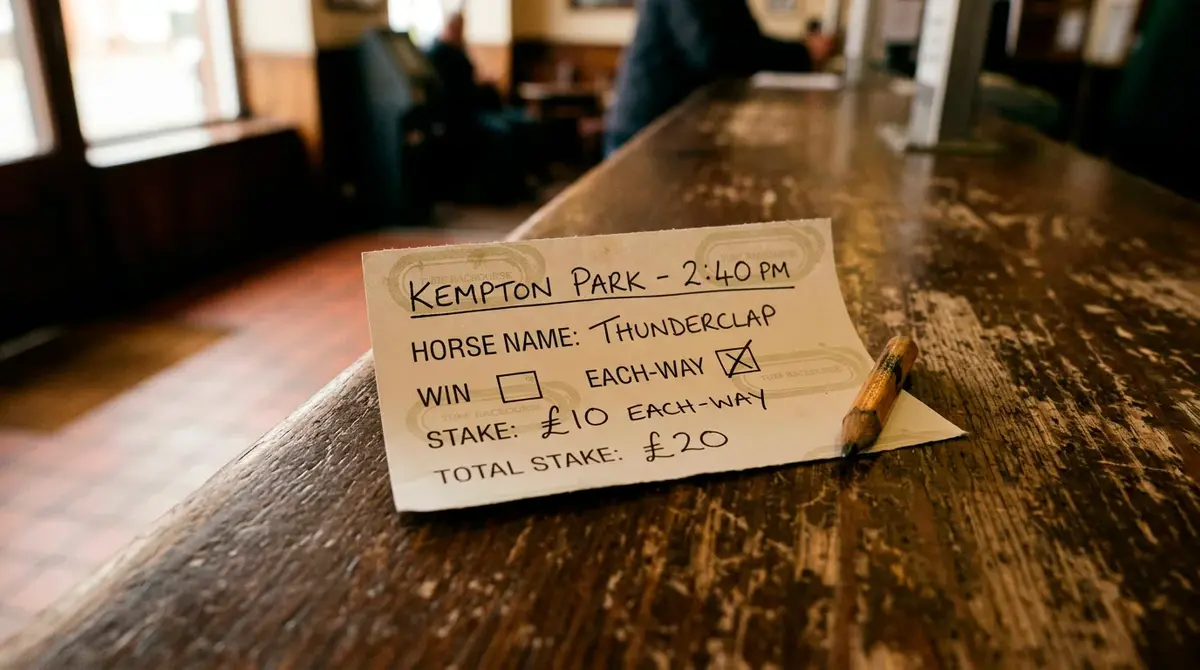
Each-way is the most popular bet in UK horse racing after the straight win, and it is also the most consistently misunderstood. The structure is simple. A five-pound each-way bet is a ten-pound total stake — five on the win, five on the place — and it pays out differently depending on whether the horse wins, places, or does neither. But under that bonnet sit half a dozen variables that can turn a sensible bet into a charitable donation, and the default assumption that “each-way always makes sense on an outsider” is, for a disturbing share of races, just wrong.
I am going to take you through the mechanics, the place terms by race type and field size, the break-even maths that tell you when each-way pays, and the situations where it is the worst bet on the card despite looking seductive. By the time we are done, you will know exactly when to click that little box on the slip and when to leave it alone.
How an each-way bet actually works under the counter
A few years ago, I watched a first-time punter celebrate her horse finishing third at Cheltenham and then come back from the counter with a face like thunder because she had been paid less than she expected. Her logic was intuitive — the horse had placed, the slip said each-way, therefore she should get her payout. Her mistake was assuming the win part and the place part paid the same way.
An each-way bet is mechanically two separate wagers, settled independently. The win part pays out if and only if the horse wins. The place part pays out if the horse finishes in a designated placing — second, third, sometimes fourth or fifth, depending on the race. The place part pays at a fraction of the quoted win odds, most commonly a quarter or a fifth, again depending on the race type. If the horse wins, both parts pay. If the horse places but does not win, only the place part pays. If it finishes outside the places, the whole bet loses and your full stake is gone.
Take a ten-pound each-way bet at 8/1 with place terms of one-quarter the odds for three places. Your total stake is twenty pounds — ten on the win, ten on the place. If the horse wins, you collect the win part (ten pounds at 8/1, so eighty pounds profit plus your ten back, equals ninety pounds), plus the place part (ten pounds at 2/1, because a quarter of 8/1 is 2/1, so twenty pounds profit plus your ten back, equals thirty pounds). Total return: one hundred and twenty pounds from a twenty-pound total stake. If the horse places without winning, the win part dies and you collect only the place part — thirty pounds return. If the horse runs fourth, you lose the lot.
The critical piece to internalise is that the place part is paid at a fraction of the win odds, not at fixed place odds. Different bookmakers quote the same horse at roughly the same win price, but the fraction they pay on the place part can and does vary by race type and field size. This is where nearly all of the long-term value in each-way betting comes from, and it is the part of the bet that casual punters almost never stop to inspect before clicking place.
Standard UK place terms that have not changed in a generation
The place terms that apply to UK horse racing are standardised across most licensed operators and have been stable for decades. They work off two variables only: is the race a handicap or not, and how many horses are actually running. Both questions get answered by the racecard before the market even opens, which means you can calculate your place terms long before you place the bet. Most punters do not bother.
For non-handicap races — conditions races, stakes races, Group and Listed events — the terms are cleaner. With two, three or four runners, no each-way betting is available: the bookmaker will not take the bet because there is no place market to speak of. With five, six or seven runners, each-way pays on two places at one-quarter the odds. With eight or more runners, each-way pays on three places at one-fifth the odds. Simple enough, and these terms apply to most Graded races and feature events outside of handicaps.
For handicaps, which are the single most popular race type in UK racing and account for the majority of festival handicap Day-by-Day cards, the place terms widen out because fields are larger and the races are deliberately competitive. With two to four runners, no each-way as before. With five, six or seven runners, two places at one-quarter the odds. With eight to eleven runners, three places at one-fifth the odds. With twelve to fifteen runners, three places at one-quarter the odds — the fraction widens because the field has grown and the bookmaker prices more generously. With sixteen or more runners, four places at one-quarter the odds, unless the race is a designated big handicap with enhanced terms, in which case five or six places may be paid as a promotional concession.
Two thirds of the mistakes I see happen at the boundary between twelve and fifteen runners, where a thirteen-runner handicap pays three places at one-quarter the odds but nine out of ten new punters have no idea that the place fraction has widened from fifth to quarter between the eight-to-eleven tier and the twelve-to-fifteen tier. This matters because a quarter-odds payout on a 10/1 chance is 5/2, whereas a fifth-odds payout on the same horse is 2/1 — a full half-point difference that translates directly into the break-even calculation we are about to do.
Handicap place terms and how the field size changes everything
Last April, in the week of the Grand National, I had fifty pounds to spend and a shortlist of six horses. I worked the terms out for every one of them before I got within sniffing distance of the slip. Two were in seventeen-runner handicaps paying four places at a quarter, one was in a twelve-runner handicap paying three places at a quarter, one was in a nine-runner race paying three places at a fifth, and two were in eight-runner conditions races also paying three at a fifth. That exercise took me maybe ninety seconds. It changed which horses I backed each-way and which I backed win-only, because for one of the shortfield fifth-odds horses, the place part simply did not compensate for the risk of my stake on the losing half.
The principle to hold in your head is that bigger fields give you better place terms, up to a point. Four places at one-quarter the odds on a twenty-runner handicap is dramatically more generous than three places at one-fifth on an eight-runner handicap. In the first case, there are four winning positions and the fraction is one-quarter; in the second, there are three winning positions and the fraction is only one-fifth. The bookmaker prices this way because the larger field is genuinely harder to read, and the market depth needs the cushion of a wider each-way payout to keep punters engaged.
The exception to the neat handicap ladder is the designated big handicap. Grand National, Cambridgeshire, Wokingham, Ayr Gold Cup and their peers — races where the field is capped at or beyond sixteen, the overround is high, and the bookmaker expects a flood of casual money. For these, most operators run enhanced place terms as a promotional concession. Five places, six places, occasionally seven places if a generous book wants to capture attention. These concessions are announced on the morning of the race or earlier, they apply to the specific race only, and they can be the single most generous each-way product in the calendar. I will come back to festival each-way in a minute, because the ante-post rhythm of these races also matters.
One thing to watch for in the data feeds. A race sometimes loses runners between overnight declarations and the off. A seventeen-runner handicap with one non-runner becomes a sixteen-runner race, but the place terms you were quoted at the time of your bet may or may not persist depending on the operator’s policy. Most licensed books hold the terms as declared at the time of the bet, which is why BOG-style protections matter, but a thin few apply the reduced terms retrospectively — especially on illiquid ante-post markets. Always check the specific operator’s rules, not the industry-standard assumption.
The break-even maths that tells you when each-way pays
Every each-way bet has a price threshold below which the bet is mathematically inferior to a straight win, even if the horse places. Working out that threshold takes two lines of arithmetic, and once you have done it a dozen times it becomes instinctive.
The break-even logic is this. For an each-way bet to be a sensible alternative to a straight win bet, the place part’s expected return over the long run must at least compensate for the increased stake cost. If the place fraction is one-quarter and you need the place part to return, at minimum, your place stake back, then the place odds — a quarter of the win odds — must be at least evens. For the place odds to be at least evens, the win odds must be at least 4/1. At shorter than 4/1, a quarter-odds each-way bet loses money on the place part even when the horse places, because the place payout does not cover the place stake.
Do the same calculation for fifth-odds terms. For the place odds to be at least evens at one-fifth of the win odds, the win odds must be at least 5/1. Below 5/1, a fifth-odds each-way is a mathematically losing place bet regardless of whether the horse places. You are betting on the place part to “get some money back” but actually paying out less than you staked on that half. The only justification is if you have a strong win opinion, in which case you would be better off simply backing the win and ignoring the place.
Combine those two thresholds with the place terms table and you get a rough rule: each-way is break-even or better at a quarter-odds terms from 4/1 upwards, and at fifth-odds terms from 5/1 upwards. These are not magic numbers. They are the minimum price below which you are structurally losing on the place part even when the place part wins. Above these thresholds, the place part contributes positive expected value, and the each-way bet makes sense as a package.
The rule gets sharper if you bring in the horse’s actual chance of placing versus winning. Odds-on favourites in UK flat racing win fifty-five to sixty percent of their races, and horses priced at 1.25 or shorter win eighty-six percent. For these short-priced animals, each-way is borderline pointless because the place part almost always coincides with a win anyway, and you are paying for an insurance policy that rarely triggers independently. Above 5/1, especially in competitive handicaps, the probability of placing without winning becomes large enough that the place part starts earning its keep, and the each-way bet pivots from dead money to genuine value.
When each-way is a bad bet and you should resist it anyway
The easiest way to lose money slowly at the races is to place-bet horses priced between 2/1 and 4/1. Every week I see it happen. A horse is 3/1 second-favourite, the punter likes the horse, reaches for an each-way slip out of habit, and the bookmaker smiles politely. At quarter-odds, the place return on a 3/1 horse is evens. You are staking two units to get back two units on the place part alone. If the horse places, you get your place stake back as profit, which is fine, but the win stake is gone. Over a long run of 3/1 each-way bets where the horse places without winning, you are breaking even on a transaction that cost you opportunity, effort and bookmaker’s margin. Over the long run of bets where the horse finishes out of the places, you lose the full stake.
The arithmetic says: if you like the horse enough to bet, back the win. If you are unsure and want the “insurance” of a place payout, be sure the price is above 4/1 for quarter-odds and 5/1 for fifth-odds, or you are paying for an insurance product that does not actually insure anything meaningful.
Short-priced favourites in big races are a particularly bad each-way proposition because the place part and the win part are too tightly correlated. Horses at 1.25 or shorter in decimal place something like ninety-three to ninety-five percent of the time. Your each-way bet is essentially a doubled-up win bet, with no real insurance benefit, because if the horse wins, the place part pays peanuts; if it places, you get your money back and no more; if it does not place — the remaining five to seven percent of outcomes — you lose everything. This is the bet casual punters do not do, and professionals absolutely never do.
The other situation where each-way underperforms is small-field conditions races with only four or five runners. Two places at a quarter of tight odds means the place return covers basically nothing, and you are paying two units of stake for a fraction of one unit of expected return. In five to seven runner non-handicaps, if you have a real opinion, back the win outright. Each-way at those field sizes is almost always worse than either a single win bet or a place-only bet on the exchange.
Each-way at the big festivals and the enhanced-place arithmetic
The Grand National is the one race of the year where each-way becomes, for many casual punters, the default bet. About two hundred and fifty million pounds was wagered on the 2025 Grand National, with Entain reporting that this was seven hundred percent more money than flowed through its books on the Cheltenham Gold Cup the same year. Most of that two hundred and fifty million was each-way, because Aintree’s big race is a thirty-four-runner handicap chase, the place terms are extended to five or six places at one-quarter the odds depending on the operator, and an each-way punt on a 33/1 outsider carries a real probability of covering its own cost via the place part.
Cheltenham Festival generates an expected four hundred and fifty million pounds of betting turnover across four days in 2026. “We expect around £450 million to be wagered across the four days of the 2026 Festival,” William Hill’s Lee Phelps put it in a recent media briefing, adding that “the contest between bookmakers and punters at Cheltenham is unrivalled in jump racing.” The each-way rhythm at Cheltenham is subtly different from Aintree’s. The handicaps at Cheltenham — the Coral Cup, the Pertemps, the Plate, the County — carry standard handicap terms with four places at a quarter in fields of sixteen or more. Some books extend to five or six places for the duration of the festival as a promotional concession, and taking advantage of those enhanced concessions is one of the genuine statistical edges available to a festival punter.
Here is the specific calculation that matters. If a standard operator is paying four places at a quarter and a promotional operator is paying six places at a quarter on the same race, the sixth-placed horse converts from a losing bet into a winning place bet at the second operator. In fields of twenty-plus runners, the probability of your horse finishing sixth when it did not finish in the top four is around five to eight per cent for a mid-priced runner and higher for an outsider. That extra payout window is worth a material uplift in expected value — large enough that professional each-way players will move their entire festival action to the most generous place concession available.
Something to watch for in ante-post markets on festival handicaps. Many books offer Non-Runner No Bet from a certain date — often a week before the race — and extended place concessions are announced in parallel. An each-way ante-post bet taken while those concessions are live can lock in a combined edge: a generous early price plus extra places, without the downside of a void bet if the horse fails to run. It is the one genuinely compelling each-way product the festivals offer, and it is largely overlooked by punters who wait until race morning.
Dead heats and Rule 4 deductions on the place part
The least understood piece of each-way settlement is what happens when the nominated finishing positions are shared, or when a horse is withdrawn between declaration and the off. Both situations are common enough that you will meet them within your first year of serious each-way punting, and both cost money in ways that are not obvious from the slip.
Dead heat. When two or three horses finish level for a paid placing — second, third, fourth, fifth — the place part of the bet is settled as a proportional dead-heat payout. The arithmetic is that you divide the place stake by the number of horses dead-heating and then pay out at full place odds on the divided stake. A ten-pound each-way bet with place terms of one-quarter the odds at 10/1, where your horse dead-heats for third place with one other runner, would settle the place part as follows: half your place stake (five pounds) wins at 5/2, and the other half of the place stake is treated as lost. You collect twelve pounds fifty on the winning half and nothing on the lost half, for a net place return of twelve pounds fifty against a total each-way stake of twenty pounds.
Dead heats are unusual in a straight win — photo finishes at the line that cannot be separated are resolved by stewards most of the time — but common enough in places two, three and four, especially in big-field handicaps with tight finishes. The point is that you do not get cheated by the dead-heat rule; you get paid proportionally. Over a long punting career, the dead-heat arithmetic averages out to neutral, but it can sting on an individual bet.
Rule 4 deduction is the other settlement wrinkle. When a horse is withdrawn from the race between the time you placed your bet and the race starting, all bets struck at prices before the withdrawal are subject to a deduction on the winnings to reflect the reduced field and shortened effective market. The deduction is applied on a scale based on the price of the withdrawn horse at the time of withdrawal — the shorter the withdrawn horse’s price, the larger the deduction. A withdrawn 3/1 favourite might trigger a thirty-per-cent deduction on your winnings; a withdrawn 20/1 outsider might trigger a five-per-cent deduction; a withdrawal at 50/1 or longer may trigger no deduction at all.
On each-way bets, the Rule 4 deduction applies to both the win part and the place part independently, so the total effect on your return is significant when a prominent market mover withdraws late. It is one of the reasons I always check the withdrawal status of ante-post bets the morning of the race — a late withdrawal of a market leader can shave fifteen or twenty per cent off the headline return I was expecting, entirely legally and entirely by the book.
Place-only alternatives and when the exchange wins
If you have reached this point you have probably noticed that each-way is essentially a bundled product — you cannot buy the place part alone from a traditional bookmaker. Either you take both parts together or you take neither. The exchanges, though, offer a place-only market, and that market is worth understanding because it decouples the decision.
A place-only bet on the exchange lets you back a horse to finish in the paid positions — usually the top three for fields of eight or more — without taking a position on whether it wins. The place market is priced independently of the win market, and the place prices reflect the aggregate of exchange liquidity rather than the fractional convention of the traditional book. You will find that place-only prices on second favourites and mid-priced runners can be materially better than the implied place price from each-way terms at the shop.
Second favourites in UK racing have a strike rate of nineteen and a half percent — seven thousand and twenty-one wins from thirty-six thousand two hundred and forty-nine runs, for anyone keeping score — and they place a good deal more often than they win. Level stakes on the win part alone loses eleven-point-eight pence per pound, but the place strike rate is closer to forty per cent. If you can get a place-only price on the exchange that reflects that actual forty-per-cent probability rather than the implied place-only extract from fifth-odds each-way terms, you have a more efficient expression of the same opinion.
There is a settled idea in racing culture that each-way is for casuals and place-only is for semi-pros. I think it is too neat a distinction. Each-way is a perfectly good product when the terms are generous — quarter-odds in twelve-plus runner handicaps, extra places on festival cards, or promotional five- and six-place concessions. It becomes inefficient when the fraction is tight, the field is small, or the horse is short-priced. Place-only on the exchange is the right expression when the win is a poor bet but the place is fair value, and it is especially strong on outsiders in big handicaps where the exchange’s liquidity is deep enough to price the place market sensibly.
The other reason to know both tools — each-way and place-only — is that the rise of affordability checks has changed the landscape of where you can actually bet what. Richard Wayman, the BHA’s director of racing, wrote on the industry blog that betting turnover in the first quarter of 2025-26 fell nine per cent year-on-year, with average turnover per Core Fixture down fourteen and four-tenths per cent. Some of that money disappeared entirely; some of it moved to exchanges, where volume is less visible to licensing regimes; some of it moved offshore. The punter who understands both the each-way product and the place-only alternative has a wider toolkit for finding value as the regulated market shifts — and the knowledge that, at the broader level of UK horse racing economics, the rules of the game are evolving faster than the marketing materials suggest.
Things I wish more each-way punters would ask me
These are the questions that come up over and over. If you can answer them before your next bet, you are ahead of ninety per cent of the shop floor.
Articles
Created by the "bettingathorseracing.com" editorial team.
