

The 40-1 that became a non-runner
Cheltenham 2022. I took 40-1 ante-post on a horse I had genuinely convinced myself was the bet of the Festival. Three weeks later the horse pulled a muscle in a routine piece of work and the trainer ruled it out. My stake was gone. No refund. No Non-Runner protection on the terms I had taken. The horse I had replaced it with lost. I was out twice, and I had earned none of it. That afternoon I wrote down the three things I now check before placing any ante-post bet.
Ante-post is the oldest and most romantic corner of horse racing betting. It is also the most unforgiving. The early price you take compensates you for a specific risk – that your horse will not run on the day – and if that risk lands, the price means nothing. This piece is about how to decide when the compensation is worth the risk and when it is not.
What ante-post really means
An ante-post bet is a bet placed before the final declarations for a race. The horse is not yet guaranteed to run. Weeks or months out from a target race, bookmakers price the field based on likely runners, recent form and yard intentions. Punters who think a specific horse is underpriced at the early line can lock in that price, accepting that if the horse does not run, the stake is lost.
The trade-off is simple but unforgiving. In exchange for better prices than will be available on the day, you accept the risk of the horse failing to appear. On the day, the same horse might be 6-1; ante-post, you took 20-1. If the horse runs and wins, you have earned an edge the race-day punter could not access. If it does not run, the race-day punter is unaffected and you are out your stake.
Historically this was the only way to bet on big races before the modern same-day market existed. Every major UK race carries an ante-post market that opens weeks or months in advance – Cheltenham Festival from November onwards, the Grand National from the previous summer, Royal Ascot from early spring, the Derby from the previous autumn. The prices on those markets move constantly as horses work, run prep races, pick up injuries or get withdrawn. The ante-post punter is reading the yards as much as the form.
Price vs risk trade-off
The headline price on an ante-post market is always higher than the same horse’s likely race-day SP, and the difference is the compensation for non-runner risk. A horse priced at 20-1 ante-post four weeks out might be 12-1 on the day, 8-1 with bookmakers’ morning of race adjustments, 6-1 at the off. You locked in a bigger number in exchange for accepting a non-running risk.
The maths is straightforward. If you assess the probability of your horse running at, say, 75%, then your effective price is the ante-post price reduced by the running probability. Take 20-1 on a horse you think is 75% likely to run and your effective “will run and win if so” price is roughly 16-1 compared to whatever the race-day price turns out to be. If you would take 16-1 on the same horse as a race-day bet, the ante-post wager is positive expectation. If you would not, it is not.
Running probability is the variable most punters underestimate. Horses at the elite level of UK racing – the 489 Jump runners rated 135-plus and 1,423 Flat runners rated 90-plus in 2025 – are fragile, highly trained animals pointed at specific targets months in advance. Between now and race day something can always go wrong: muscle strains, virus, lost work, jockey booking issues, ground preferences that stop appearing in the forecasts. Estimating how often an elite horse ante-post priced for a specific race actually runs in that race is the single hardest judgement in the trade.
How NRNB changes the picture
Non-Runner No Bet is the concession that makes ante-post sensible rather than reckless. NRNB guarantees that if your horse does not run, your stake is refunded. It does not always apply on ante-post markets – typically it kicks in closer to race day, often from final declarations or the week of the race – but when it does apply, it transforms the bet.
The interplay between early-price ante-post (no NRNB, bigger price) and late-period ante-post (NRNB, smaller price) is where a lot of the trade happens. An early ante-post price might be 20-1; the same price with NRNB protection might be 14-1. The seven-point gap is the cost of the insurance. If you think your horse is 80% likely to run, you should be ambivalent between 20-1 no NRNB and 16-1 with NRNB. If you think it is 60% likely to run, NRNB is the obvious choice.
Most ante-post punters I know work in two modes. They take speculative early prices on horses they think have strong stables behind them and specific target races, accepting non-runner risk for the larger prices. Then they top up at NRNB once it becomes available, locking in a smaller but protected position on the same horses. The combination of the two phases – speculative early and protected late – turns out to be the most robust way to run an ante-post book across a big festival.
Declaration and final field
The declaration stage is the moment a horse becomes a confirmed runner. For flat races, declarations are typically two days before the race; for National Hunt, usually 48 hours or so before. Before declarations, a horse entered for a race is still a possibility rather than a certainty. After declarations, the horse is named in the overnight card and is almost certain to run barring a veterinary issue.
The final-field stage collapses much of the ante-post uncertainty. Markets re-price heavily at declaration time because the field shape is now known – who is running, what weights, which jockeys. Early ante-post prices that looked appealing weeks out can look generous or misguided once the field is confirmed. A horse you took at 20-1 that is now one of three serious contenders at the declaration stage is worth more than it was at the time; a horse that declared on its “easy” target while its main engagement is at a different meeting is worth less.
For the Grand National specifically, the field is now capped at 34 runners, cut from the previous 40 after safety reforms. The number of entries has tightened too – 78 for the 2026 running against 126 a decade ago – which changes the ante-post dynamics because fewer horses are genuinely in the frame and the market is slightly more concentrated. Those structural shifts reshape how the ante-post market behaves around the race every year.
Case studies of ante-post movers
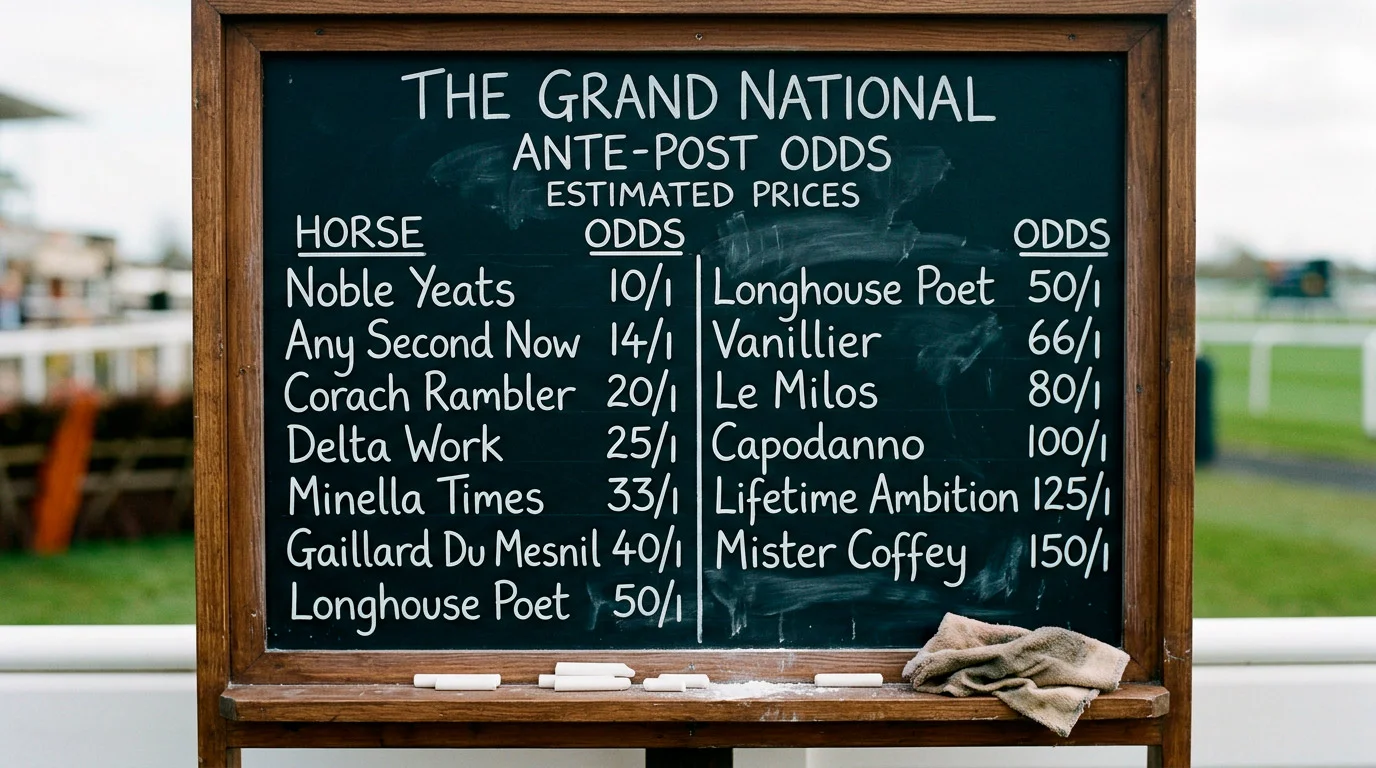
The 2022 Grand National is the textbook case of ante-post risk and reward in one race. Noble Yeats, ridden by the amateur Sam Waley-Cohen in his final ride before retirement, won at 50-1. Punters who had taken the price weeks out had banked an enormous-price winner. Those who had taken 20-1 ante-post on better-fancied rivals had paid the opportunity cost of being wrong.
William Hill’s spokesperson Lee Phelps, previewing the 2026 Cheltenham Festival, estimated “around £450 million to be wagered across the four days of the 2026 Festival. The contest between bookmakers and punters at Cheltenham is unrivalled in jump racing.” A meaningful portion of that £450 million moves in ante-post markets weeks before the first race, and the ante-post winners and losers are decided by which horses stay sound and on target for the specific race they were backed for.
The pattern repeats every festival. Horses priced at 16-1 or 20-1 in November slide to 8-1 or 10-1 by February as their prep runs confirm the ante-post thesis. Other horses drift from 10-1 to 25-1 as their preps disappoint or injuries emerge. The ante-post market is a continuous referendum on the target race, and reading it carefully across months of build-up is what separates the speculators from the disciplined players.
When ante-post belongs in the bet slate
My own rules after that 2022 Cheltenham experience. First, I only take ante-post on races where I have a specific angle the market has not yet priced – a horse whose recent form points to a target I think is underrepresented in the prices. Second, I cap ante-post stakes at a fraction of my normal race-day stake, usually half, because the non-runner risk doubles the variance of the bet. Third, I top up at NRNB once it becomes available, treating the early position as a speculative overlay on the race-day book.
Done this way, ante-post becomes a positive-expectation operation across a full season rather than a coin flip. The edge is in being early on horses the market will shorten. The cost is the stakes lost on non-runners. Net of those two effects, a disciplined ante-post approach to the main festivals is one of the few places in British racing where an amateur can still find substantial edge. For the broader market-mechanics context, the pillar on betting at horse racing is the anchor.
Articles
Published by the bettingathorseracing.com team.
