

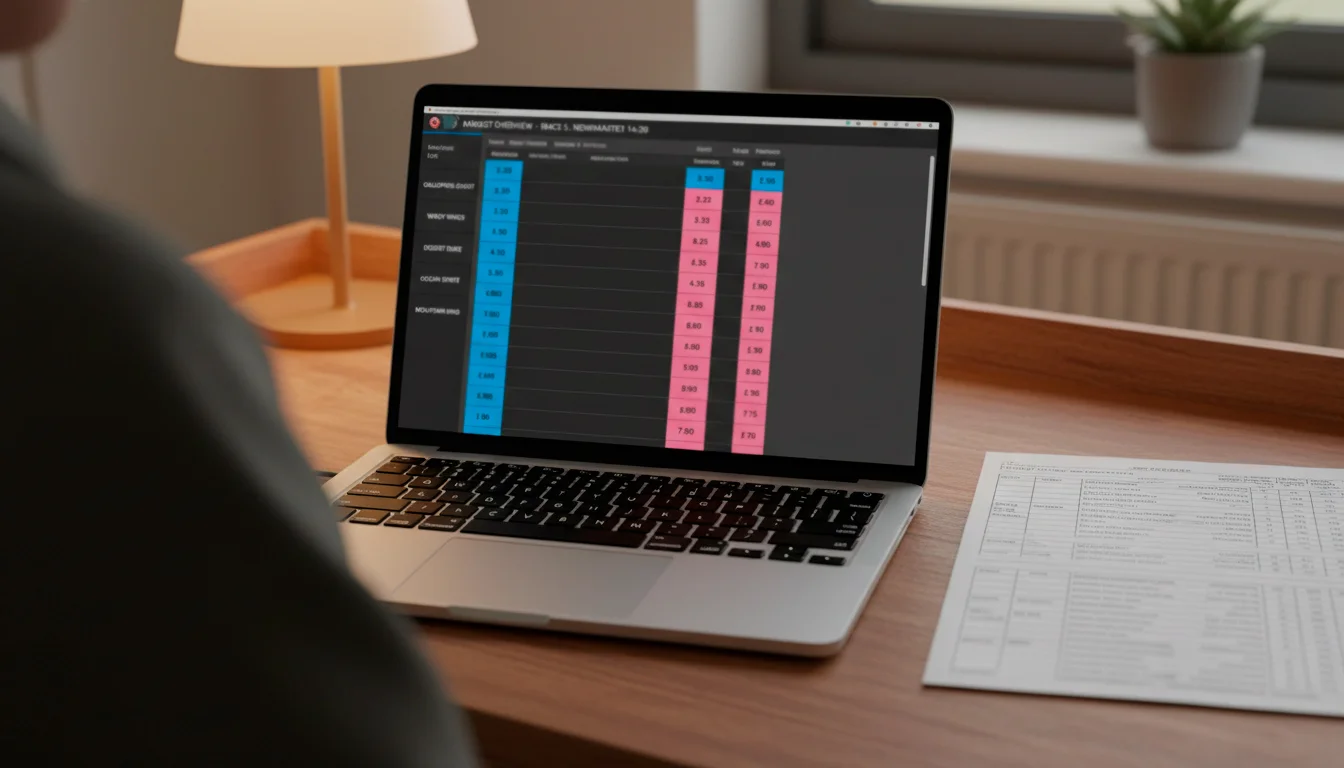
The day I lost £80 on a horse that won
Kempton, February 2019. I had laid a short-priced favourite at 2.12 for £100 liability. The horse won easing down. On a bookmaker’s slip that would have been a minor misjudgement. On the exchange it was an £80 loss, net of commission, and I learned more about pricing in those ninety seconds than any book had taught me in five years. Laying is a different sport to backing, and if you have only ever been a high-street punter, the exchange will educate you quickly and sometimes expensively.
Betting exchanges changed UK racing in 2000 and nothing in the industry has quite recovered its shape. Bookmakers still dominate turnover, but the exchange is where the sharpest prices form, where professional punters make or break their seasons, and where the market essentially tells you what every other informed participant thinks about a race. Ignoring the exchange is ignoring a live feed of informed opinion.
Exchange vs bookmaker
A bookmaker quotes you a price and you take it or leave it. The exchange does not quote prices at all. It hosts a market in which punters quote each other. If you want to back a horse at 5.0, you either accept the best price another user is offering to lay at, or you post your own request to back at 5.0 and wait for someone to match you. Both sides of the wager come from other punters. The exchange is a matchmaker, not a counterparty.
That structural difference produces tighter markets. The overround on a competitive Saturday race on the main UK exchange typically runs at 101-to-103%, compared to the 110-to-115% a high-street book might post on the same race. That margin does not come free – the exchange charges commission on net winnings, typically 2% to 5% depending on your activity level – but the edge versus board pricing is substantial on liquid markets.
Liquidity is the critical word. Big Saturday handicaps, Group 1 Flat races and Cheltenham Festival cards attract enormous money on the exchange; a Monday afternoon card at Southwell attracts a fraction of it. A market with thin liquidity quotes prices you could never actually get matched at, because the amounts available at those prices are tiny. The exchange’s reported best price is real; the £500 you want to get on at that price often is not.
How to place a lay
A lay bet is the bet a bookmaker makes every time they take your money. You are betting that a horse will not win. If you lay a horse at 4.0 with a liability of £30, you are committing to pay out £30 if the horse wins; if it loses you collect the £10 stake the backer posted on the other side of your trade, minus commission.
The maths trips up first-time layers. Laying at 4.0 means that every £1 of stake the backer posts creates a £3 liability for the layer. Liability, not stake, is the number that matters when you are laying. On the exchange interface you typically enter your lay stake – the backer’s stake you are willing to absorb – and the platform shows your liability at the current lay price. Enter a £10 lay stake at 5.0 and your liability is £40. Enter £10 at 2.0 and your liability is £10.
Laying short-priced favourites is how most new exchange users lose money. A 1.5 lay looks like free money – you are paying half of every winning stake – until the favourite wins 60% of the time and you have been bleeding liability on every race. The flat racing number that should stop you is the one I opened this piece with: odds-on favourites in UK flat racing win 55 to 60% of races, and priced at 1.25 or shorter they win 86% of the time. Lay a heavy favourite and you are not pricing against the market; you are pricing against arithmetic.
Laying earns when it is done to horses you have genuinely identified as overpriced. That is a different discipline to backing. It requires you to have a view on a horse’s ceiling rather than its chance. A horse priced at 4.0 that you believe is genuinely a 5.0 chance is a lay candidate. The same horse priced at 4.0 you believe is a 3.5 chance is obviously not.
Commission and true price
Commission quietly reshapes every exchange price. A reported back price of 6.0 with 5% commission pays you an effective 5.75 on your winnings. A reported lay price of 3.0 with 5% commission keeps 5% of the stake you absorb when the lay lands, which reduces your effective return on laid stakes.
The arithmetic matters because on a competitive market the exchange back price is often only marginally better than a sharp bookmaker’s board, and commission can erase the gap entirely. A 6.0 on the exchange minus 5% is 5.75, which is only two ticks better than a 5.7 on the board. The trade-off: you can often get larger amounts on at exchange prices than a bookmaker will let you have at board prices, especially if you are a winning player whose bookmaker accounts have been restricted.
Most serious exchange users work out their effective prices in real time rather than trusting the headline number. On most platforms you can see a “true price” display that factors commission into the quoted line. Use it. The difference between a matched bet at 6.0 at 2% commission (effective 5.9) and the same bet at 8% commission (effective 5.6) is the difference between a winning season and a break-even one.
Liquidity by race type
If I open an exchange at 2.30pm on a Saturday during the Flat season, a Group race at Ascot might have £800,000 matched in its win market alone. The same platform on a Tuesday afternoon with a Brighton handicap at 3.00pm might show £8,000 matched across the field. Both are the same exchange. The prices quoted on both look roughly sensible. The execution reality is utterly different.
Liquidity follows attention. The biggest Saturday fixtures, televised cards, the Festival at Cheltenham, the Grand National meeting at Aintree, Royal Ascot, the Derby – these have deep markets where £5,000 or £10,000 can move through without shifting the price. Midweek evening cards at lower-grade tracks have markets thin enough that a £200 bet can move the price perceptibly. Thin markets invite shenanigans too: “spoofing” – posting large orders you never intend to see matched, to move the price – happens more on thin markets than thick ones.
The UK remote betting sector generated £2.6 billion in GGY in the financial year to March 2025, and horse racing accounted for £766.7 million of that. The exchange’s share of the total is smaller than the bookmakers’ share, but the exchange’s share of the “informed” money – the money that moves the price – is disproportionately large.
In-play exchange behaviour
Watch an exchange during a race and you will see something a bookmaker’s board never shows you: prices reacting to the race in real time. As horses move, jockeys commit, the commentary shifts, the price moves. A Flat race with a two-furlong run-in gives an in-play punter maybe thirty seconds of useful information to act on. A three-mile chase gives eight minutes of it.
In-play is where many exchange professionals earn their living, and it is also where amateurs lose theirs. The information flow is brutal and the interface changes position constantly. I have watched confident punters freeze when the horse they backed ante-post drifted from 6.0 to 8.0 in the early stages of the Champion Hurdle – a market move that was, in retrospect, obvious – and take no action, then watch the horse finish fifth.
Two practical rules from my own in-play experience. First, decide before the race what in-running prices would trigger a trade, and write them down; do not improvise when adrenaline is pricing your decisions. Second, treat in-play betting as a discipline requiring its own practice. The markets move fast enough that two or three poor trades in succession can tilt your equity in a way a normal Saturday cannot.
Where the exchange belongs in a punter’s toolkit
I use the exchange for three specific jobs. I use it to get on when my bookmaker accounts are restricted or when the bookmaker’s limits are too low for the size I want to bet. I use it to lay horses I have identified as genuinely overpriced, which is a small fraction of my activity. And I use the price discovery function – watching the exchange’s best prices before big races – as the single most reliable intelligence feed in British racing.
What I do not do is treat the exchange as a general-purpose replacement for board pricing. On thin markets the quoted prices are phantoms. On short-priced favourites in big fields the margins are too tight to earn real edge. On ordinary weekday cards a sharp bookmaker’s offers – Best Odds Guaranteed, Non-Runner No Bet, extra places – frequently beat exchange value net of commission. The exchange is a tool, not a religion. For the wider map of how it sits alongside bookmakers and Tote, the pillar on betting at horse racing is the place to start.
Articles
Published by the bettingathorseracing.com team.
