

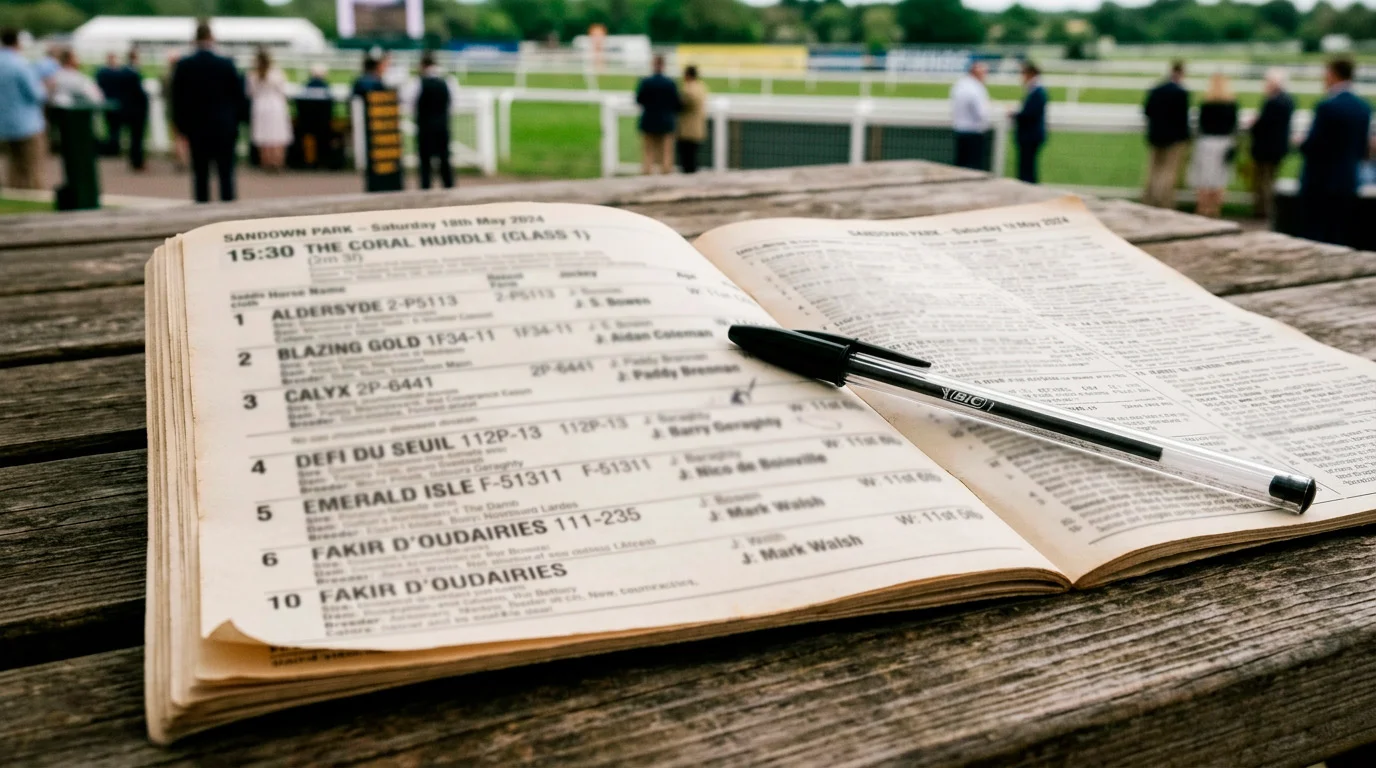
Why the racecard is the only tool that actually matters
The first racecard I read properly was at Kempton on a wet Wednesday in 2017. I had a printed Racing Post, a biro and no idea why the little numbers next to a horse’s name looked like a postcode. Nine years later, every serious betting decision I make starts and ends with the racecard. Tips, pundits, social-media whispers – none of them survive contact with the page in front of me.
Newcomers treat the card as a directory. Experienced punters treat it as a compressed intelligence file. The same rectangle of text carries a horse’s recent form, its weight burden, its draw, its trainer’s current shape, the jockey’s allowance and a dozen subtler tells. Miss any of them and you are not betting on the race in front of you – you are betting on the race in your head. This guide walks through a UK racecard the way I walk through one on the morning of a meeting, top to bottom, with the specific signals that change a price in my book.
Anatomy of a racecard
Imagine opening the racecard for the 3.15 at Newbury. Before you look at any runner, the header is already telling you half the story – class, distance, going, prize money. I do not glance at runners until I have read the top strip.
The header carries the race name, the class (Class 1 down to Class 7), the official race type (handicap, conditions, novice, maiden) and the distance in furlongs and yards. A 2m 4f novice hurdle at Class 4 tells me within two seconds that I am looking at horses early in their jumping career over a middle-distance trip. A Class 2 handicap chase over three miles is a different exercise entirely.
Underneath the header the fields read left to right: saddlecloth number, draw in brackets (Flat only), silks block, horse name, recent form figures, age and weight, headgear symbols, days since last run, jockey, trainer and official rating. Two details punters routinely skip: the days-since-last-run number and the headgear symbols. Both are in small type and both move prices. A horse having its first run back after 180 days is not the same animal as the one that ran well eight days ago. A first-time visor from a yard known for that tactic is worth a look before the market shortens.
With the British fixture list holding steady at 1,460 in 2025 after 1,468 the year before and 1,488 in 2023, the volume of cards to process is relentless. Reading them quickly and cleanly is a skill that pays for itself inside a month.
Form figures decoded
My father’s method for reading form figures was to count the ones. More ones, better horse. He was a postman, not a handicapper, and he still backed more winners than most tipsters. The method is crude but contains a truth: form figures are a compressed history, and the shape of that history tells you almost everything about a horse’s trajectory.
The sequence is read left to right, oldest run on the left, most recent on the right. A zero means the horse finished outside the top nine. A slash “/” marks a season break. A dash “-” marks a change of year within the same season. So “12/435-1” is a horse that won, finished second, had a season break, came back to run fourth, third, fifth, then – after another turn of the year – won first time back. A completely different beast to a horse reading “112345”: a steady downward drift suggesting regression, lameness, or the handicapper catching up.
Letters among the numbers change the picture again. “P” is pulled up in a jumps race, “F” fallen, “U” unseated rider, “R” refused, “B” brought down, “C” carried out. One P in ten runs is noise. Two in three is a warning. A P over fences on heavy ground followed by two clean wins over hurdles on decent ground is not the same signal as three Ps in a row across every surface.
The figure I weight most heavily is the most recent. But I also read the figure three back, because that is often the last time the horse ran in conditions resembling today’s. The 2024 Festival results make the point: favourites went in at only seven of twenty-one races, and several winners had form figures with a zero or a P buried in the middle. The market was reading the recent run. The figures three and four back were the ones that mattered.
Weight and official rating
Here is a confession: for my first two years of betting seriously, I ignored weights entirely. I thought they were a tax on favourites I did not need to worry about. I cost myself real money. The official rating block is the single most important number on a handicap race card, and the weight the horse carries is that rating converted into pounds.
The British Horseracing Authority publishes an official rating for every horse that has run enough times to earn one. Horses in a handicap carry weight in proportion to their ratings: the top-rated horse carries the most, the bottom-rated horse carries the least, and the weights are scaled so a perfectly handicapped field would finish in a line. That does not happen. Handicappers lag reality by a run or two, and that lag is where the value lives. A horse whose rating is ten pounds above its true current ability is being crushed under weight it does not deserve. A horse ten pounds below its ability is getting a free lunch.
The weight column is written as stones and pounds: “9-7” means nine stone seven, “11-12” is eleven stone twelve. Top weight in a Class 2 handicap might be 10-0; bottom weight in the same race might be 8-10. That difference is about nineteen pounds and, on a middle-distance trip, nineteen pounds is roughly two lengths at the finish.
A horse classed 90-plus on the Flat or 135-plus over jumps is genuinely quality. In 2025 there were 1,423 Flat runners rated 90 or higher and 489 Jump runners rated 135 or higher in Britain, almost identical to 2024’s 1,398 and 490. The top of the ratings ladder is not getting thinner, which matters when you are deciding whether a Class 3 handicap at Haydock is really a Class 3 field or a Class 4 race with one ringer on top.
Draw and silks
A punter on the rail at Chester once told me, “Forget the form, back the draw.” He was exaggerating, but only slightly. On some courses the stall a horse starts from matters more than its last three runs combined.
The draw applies to Flat races and is shown in brackets next to the saddlecloth number. Draw one is the inside stall; the highest draw is the outside. On a left-handed course with a short run to the first bend, inside draws usually enjoy a structural advantage. On a right-handed sprint like Chester, low draws are gold dust. On a long, fair track with a straight run to the turn, draws can matter very little.
The critical thing is to read the draw alongside the distance and the course shape. Chester over five furlongs with a full field is one race; Newmarket’s July Course over a mile is essentially a different sport. I keep a mental list of the six or seven British courses where draw matters enough to change a price, and the rest I note only if something extreme is happening.
Silks are the colours the horse’s owner registers with Weatherbys. On a televised race they are the one detail the commentator relies on to call the finish, so knowing the silks helps you follow the race live. On a betting level, silks also tell you the owner, and the owner is occasionally useful information: some owners run horses sparingly and only when they expect them to run well, others churn entries through every week. Both patterns matter at the margin.
Trainer and jockey hints
The trainer and jockey columns are the last thing many punters look at, and that is backwards. Britain has roughly 14,000 horses in training at any one moment, and the yards that look after them do not all share the same current shape. A trainer on a 20% strike rate over the last fortnight is a different animal to one going through a viral patch and running at 3%. The card tells you which is which, usually through a fourteen-day strike-rate box.
Jockey claim is the other detail I always check. Apprentice and conditional riders receive a weight allowance – usually three, five, seven or ten pounds – to compensate for their inexperience. A seven-pound claimer on a horse in a competitive handicap is effectively racing it at seven pounds below its rated weight. In a tight field that is a real structural edge.
Trainer-jockey combinations matter too. When I see a yard book a jockey they almost never use, I read it as significant. When I see the same apprentice ride for the same yard for the thirtieth time in six weeks, I read it differently – often as a signal the yard thinks that horse fits the rider’s style. As the British Horseracing Authority put it in its 2024 parliamentary submission, racing has “direct revenues in excess of £1.47 billion” and supports an ecosystem in which every trainer’s win matters to that yard’s economic survival. Trainers are not running horses for fun.
Putting the card to work on race day
My morning routine takes about twenty minutes per card at a standard weekday meeting and closer to an hour for a Saturday or a festival day. I read the header, scan the field for headgear changes and days-since-last-run, mark the three or four horses whose form figures show a positive trajectory, then cross-reference their weights against the official ratings and against each other. Only after that do I look at the market. If my reading of the card tells me the third favourite should be shorter than the second favourite, I have found something worth investigating.
The racecard will not hand you winners. What it will do is stop you backing horses the card has already told you not to back. In my experience that filter is worth more than any tipping service I have ever paid for. The pillar guide on betting at horse racing covers what to do with those shortlisted horses once you have built them from the card upwards.
Articles
Written by the editors at bettingathorseracing.com.
