

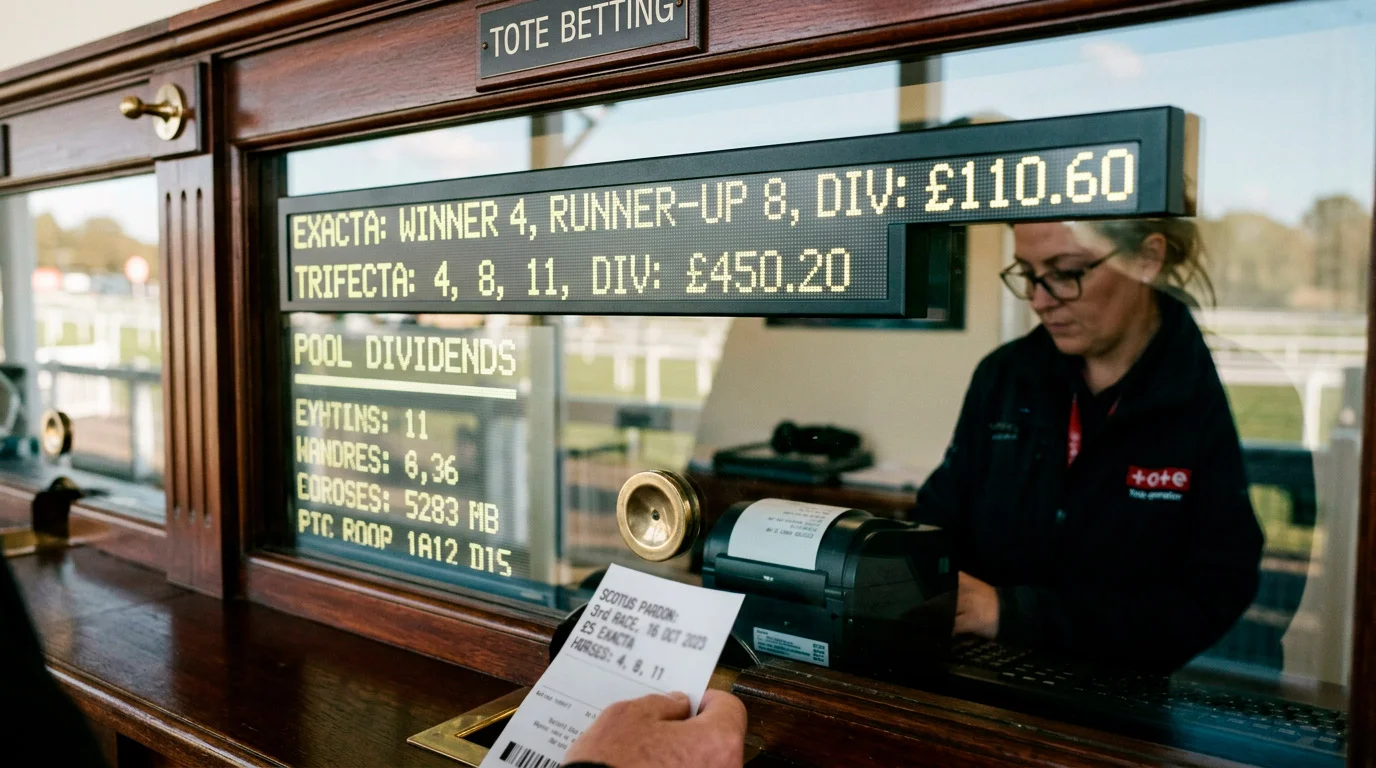
Where the bookmaker stops being your opponent
I spent my first three years of serious betting treating Tote Exacta and Tote Trifecta as glorified lotteries. A friend at York in 2020 – a professional who had been betting racing since the early 1990s – pointed out on a Dante Festival Thursday that my forecast slip, if placed as a Tote Exacta instead, would have paid roughly double. I went back through the year’s slips and ran the numbers. He was right. I had been leaving real money on the bookmaker’s counter because I did not understand the pool products.
Tote order-of-finish pools – Exacta, Trifecta, Superfecta – are the Tote’s answer to fixed-odds forecast and Tricast bets. They operate on entirely different economics. You are not betting against a bookmaker; you are betting against every other pool participant. The dividend is decided after the race by dividing the pool between winning ticket-holders. On the right races, the pool dividend routinely beats the fixed-odds equivalent. On the wrong races, it does not come close.
Tote pool mechanics
Every Tote pool works on the same principle. Stakes go into a pool, a takeout is deducted (usually 19 to 23% depending on the product), and the remaining fund is divided among the winning ticket-holders. There is no fixed price set before the race; the dividend is whatever the arithmetic produces once the stakes have settled and the winners are confirmed.
The takeout on Tote Exacta in the UK sits around 19%, Trifecta around 23%, Superfecta higher still. Those rates are painful compared to a bookmaker’s implied overround on a similar market, but the dividend volatility compensates. When the Tote pool is dominated by casual money on favourites, an outsider-heavy finish can produce dividends three or four times what a priced CSF forecast would pay on the same pairing.
Liquidity is the variable that makes or breaks the proposition. Saturday televised races pull significant pool money and produce meaningful dividends. Midweek all-weather cards pull fractional amounts into the pools and the dividends can be almost arbitrary – sometimes dwarfing anything a bookmaker would quote, sometimes worse than SP on the same pairing. Reading the pool size before committing is essential.
Exacta structure
Tote Exacta is the pool equivalent of a straight forecast: pick the first and second in the correct order. The minimum unit stake is usually 50p or £1, and the dividend is paid on each winning combination at the declared dividend per £1 unit stake.
A winning Tote Exacta where the dividend is declared at £45.20 returns £45.20 per £1 unit stake. A 50p unit stake returns £22.60. The declared dividend already accounts for the pool’s takeout and the division of the remaining fund among winning tickets, so the figure you see is what you actually collect.
Exacta perms let you cover multiple combinations. A three-by-three perm – any of three horses to win, any of three to be second – produces 3 × 2 = 6 combinations (you cannot perm the same horse as first and second). At a 50p unit, a six-combination perm costs £3. If one line lands at a £30 dividend, you collect £15 (£30 × 50p) and have paid £3 for the perm, netting £12.
Banker perms are cheaper and more disciplined. One horse fixed as winner, three alternatives for second, is 1 × 3 = 3 combinations. At 50p that is £1.50 in stakes. Exacta banker perms are the favourite structure of serious Tote players because they force commitment to a specific winner while still catching reasonable alternatives for second.
Trifecta structure
Tote Trifecta extends the concept to three horses in correct order. Dividends escalate dramatically. A winning Tote Trifecta in a competitive field commonly pays £500 to £1,500 per £1 unit stake; occasional outsider-heavy finishes produce £5,000 or £10,000 dividends.
The unit stake for Tote Trifecta is usually £1, and perm costs can climb quickly. A three-by-three-by-three perm (any of three horses in each finishing position) produces 3 × 2 × 1 = 6 meaningful lines after excluding same-horse combinations, costing £6. A four-by-four-by-four perm is 24 lines at £24. Bankers again help: one horse fixed as winner, three for second, three for third, produces 1 × 3 × 2 = 6 lines for £6.
Trifecta is available only on handicap races with a minimum number of runners, usually eight or more. The restriction is partly about pool size (smaller fields produce dividends that would be too small or too large to be commercially sensible) and partly about ensuring enough complexity to justify the product. Group races and conditions races rarely offer Trifecta.
The strategy point most newcomers miss: a Trifecta banker on a short-priced favourite is usually a poor bet. If the favourite wins at even money, enough of the pool was backing that horse in the winner’s position that the dividend collapses. A Trifecta banker on a 7-2 or 9-2 horse you have specifically identified as the likely winner produces a much higher expected dividend if the banker lands.
Superfecta and Placepot boundary
Tote Superfecta takes the concept to four horses in correct finishing order. The probability of hitting one is brutal – in a 12-runner race it is roughly 1 in 11,880 at random – and Superfecta dividends reflect that difficulty. A winning Superfecta on mid-priced runners can pay £5,000 to £20,000 per £1 unit stake.
Most punters who play Superfecta play heavy perms. A three-by-three-by-three-by-three perm produces 3 × 2 × 1 × 1 × multiple combinations that work out to dozens of lines, costing £30 to £80 at typical unit stakes. The return calculation is that if the perm lands, a single winning line pays the full dividend.
Placepot sits at the boundary with Superfecta philosophically. Both require a chain of correct predictions across multiple races or multiple positions. The mechanics differ: Placepot requires horses to place in six consecutive races, Superfecta requires four horses in exact order in one race. The bankroll demands and the strike-rate shape are different too.
Context on the Tote’s place in the wider market: UK horse racing remote betting GGY was £766.7 million in 2024-25, and UK remote betting generated £2.6 billion total across all sports – football the largest at £1.3 billion. The Tote pool products contribute a minority share of that horse racing figure. The dominant bet types are fixed-odds win and each way. The pool pools that exist are relatively concentrated, which affects the variance and reliability of the dividends.
Tote vs fixed-odds value
The comparison most punters should be running in their head before every forecast or Tricast bet is: does the Tote Exacta/Trifecta pool pay more than the bookmaker’s CSF dividend on the same pairing or trio?
On big-field Saturday handicaps with casual money concentrated on favourites, the Tote pool usually wins. The CSF formula is relatively tight; the Tote pool is distorted by uninformed money, which leaves informed outsiders underpriced in the pool. A 6-1 and 10-1 pairing in a 16-runner Ebor handicap might produce a CSF dividend of £40 to £50 per £1, while the Tote Exacta dividend on the same pairing might be £70 to £100. The gap is the informed-vs-uninformed money split in the pool.
On small-field Group races the pattern often reverses. Pool money in a six-runner Group 1 is too thin and too concentrated among the two or three likely combinations for outsiders to produce generous dividends. CSF at bookmaker prices is usually cleaner in those races.
As the British Horseracing Authority has put it in parliamentary submissions, the sport’s “direct revenues in excess of £1.47 billion and total annual contribution to the UK economy of £4.1 billion” rest on every part of the betting market pulling its weight. The Tote’s contribution to that figure is proportionally smaller than the fixed-odds bookmakers’, but the product remains the only genuine alternative pricing mechanism for order-of-finish bets. Using it selectively – on the races where the pool economics favour the informed punter – is how the serious Tote player operates. The pillar on betting at horse racing covers the wider betting landscape these products sit within.
Articles
Published by the bettingathorseracing.com team.
