

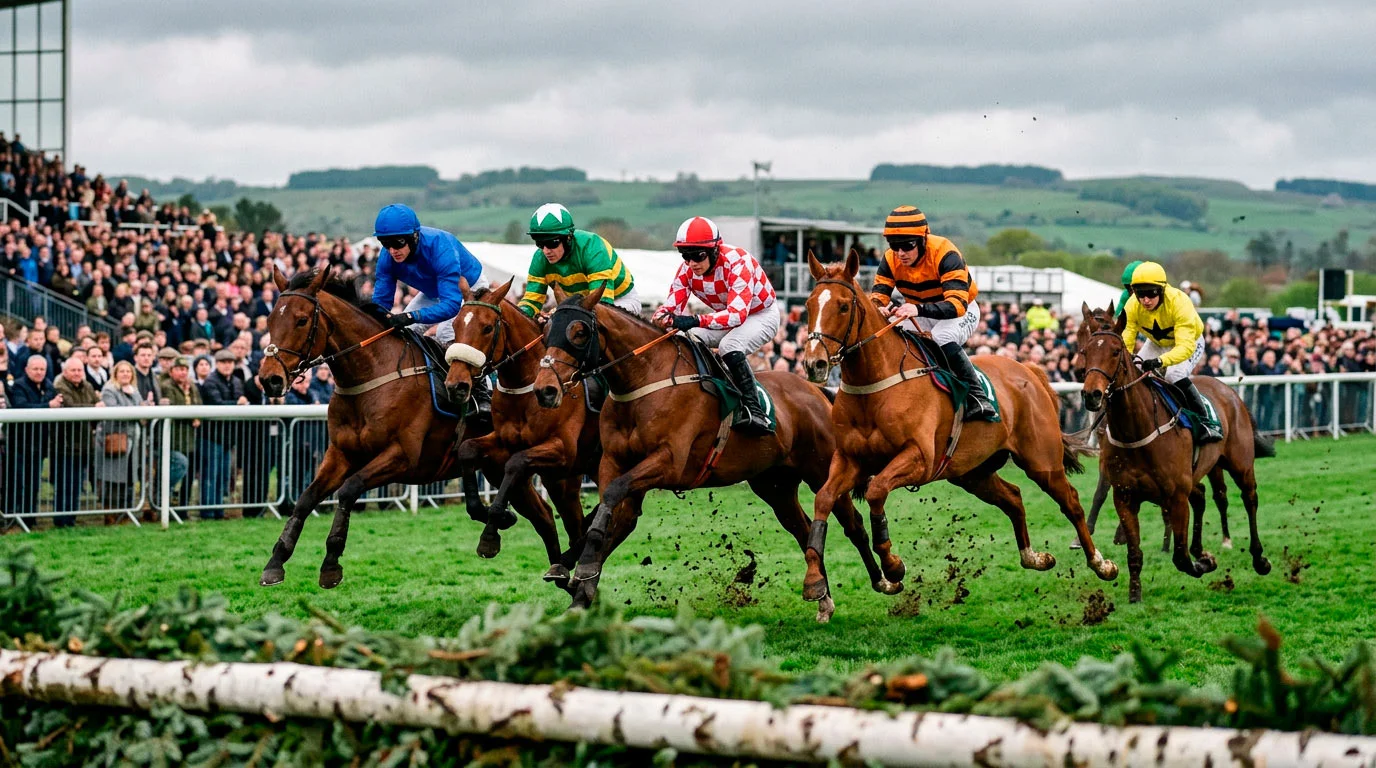
The spring race that always seems to produce a shock
The Scottish Grand National runs at Ayr each April, two weeks after its English cousin at Aintree. Four miles, heavy fences, thirty runners, a handicap chase that has produced more double-digit winners than any comparable race on the British calendar. My first bet on the race was at the age of 23 – £5 each way on a horse I had read about in the Racing Post – and it finished third at 25-1, producing a return that felt disproportionate to the effort I had put in. The race rewards the punter who studies it and punishes the one who drops in casually thinking a name will do.
The Scottish National sits inside a weekend of strong Ayr racing that marks the effective end of the Jump season’s main programme. It is less televised than Aintree, less ante-post-discussed than Cheltenham, and consequently better-priced at the margins. For punters who have fatigued on the March and April Festival betting rush, Ayr offers a fresh analytical challenge with real value still on the board.
Race profile at Ayr
The Scottish Grand National is a Grade 3 handicap chase run over approximately four miles, with 27 fences. The race is worth around £200,000 in total prize money, with the winner’s share in the £100,000-plus range – a significant event commercially but a fraction of the Aintree National’s £1 million prize fund.
Ayr racecourse is a left-handed, relatively flat track with long straights and comparatively mild undulations. The fences are not as imposing as Aintree’s, but the four-mile distance and the typical late-April going – often good to soft but capable of ranging to heavy – make the race an attritional stamina test regardless of specific jumping demands.
Field sizes are typically in the high 20s to low 30s, giving the race meaningful betting liquidity and strong each-way place terms – usually five or six places paid on a full-field race. The declaration stage produces the final running numbers, and the market moves substantially between ante-post pricing and race-day pricing as non-runners drop out.
Stamina demands of 4 miles
Four miles of chasing at Ayr is a different test from four miles at Aintree. Aintree’s National-course fences take a physical toll that shortens effective stamina requirements; at Ayr the fences are kinder but the pace tends to be more sustained, and horses who are genuinely three-mile specialists can struggle in the final half-mile. The stamina signal is the single most important form angle in race analysis.
Horses with proven four-mile form – the Eider Chase at Newcastle in February is the traditional key prep – tend to price efficiently for the race. Horses stepping up from three miles or three-and-a-quarter generally carry a premium that does not reflect the stamina risk. A horse whose best runs have been over shorter trips, arriving at Ayr on the back of a win over three-and-a-half miles, looks statistically more attractive than its recent form suggests because the extra half-mile is real.
Going is the other stamina factor. Heavy ground at Ayr reshapes the race entirely: stamina specialists flourish, horses with lighter action struggle, and the winning distance tends to widen. A Scottish National run on good to soft is a different race to one run on heavy, and the horses best suited to each condition only partially overlap. Punters reading the form need to weight recent runs by the ground on which they were achieved.
Long handicap reading
The Scottish National weights ladder stretches from top weight at around 11st 10lb down to a typical bottom weight of 10st 2lb – a 22-pound spread. Below that, a substantial proportion of the field runs off long-handicap weights, carrying the minimum permitted without the rating pound-for-pound relationship holding.
Long-handicap runners are historically well placed at Ayr. The stamina test and the fence-jumping demands cumulatively favour experienced, hard-knocking horses whose handicap ratings have been compressed downward by recent losses. A horse carrying 10st 2lb off an official rating that might imply 9st 6lb if the race had a lower bottom weight is essentially running with weight relief, and the effect over four miles is meaningful.
The BHA projected in its 2025 Racing Report that the number of runs in Britain in 2027 will be 6-7% lower than in 2024. Fewer runs means smaller horse populations at specific rating bands and more runners at long-handicap weights in the big staying handicaps. The Scottish National is likely to continue seeing a large proportion of its field at or near the minimum weight, and the long-handicap angle will remain the single most productive analytical frame for the race.
Recent winners patterns
Looking across recent Scottish National winners, patterns emerge. Ages in the 8-to-10 range dominate; horses older than 10 are still represented but less frequently. Previous four-mile form is almost invariably present, usually with a win or strong place in the previous 12 months. Weights of the winners cluster toward the lower half of the weights ladder, consistent with the long-handicap angle.
Trainer patterns are also instructive. A handful of northern and Scottish yards have consistently strong records in the race, partly because their horses are based close enough to Ayr to travel without the preparation disruption southern raiders face, and partly because these yards target the race specifically with horses suited to its particular demands. The 2024 BHA Cheltenham Festival data showed favourites winning at a 33% strike rate (7 of 21 races); Scottish National favourites land at a substantially lower rate, reflecting the race’s strong outsider-friendly profile.
Pricing behaviour on the race follows the pattern. Favourites typically go off at 5-1 or 6-1 – relatively longer than favourites in championship races – reflecting the field depth and the stamina uncertainty. Second and third favourites sit around 8-1 to 12-1. The wider market extends deep into double figures, with a cluster of 20-1 to 33-1 runners who have genuine profile on course, distance and going. Value hunters target this band.
Each-way angles for Ayr
Each-way betting earns its keep at Ayr precisely because the field depth produces meaningful place terms and the outsider-friendly race profile means longer-priced horses land in the frame more often than in tighter championship races. UK Flat racing odds-on favourites winning 55 to 60% of races and priced at 1.25 or shorter landing 86% – those numbers are from a different product entirely. The Scottish National is the opposite case: a race where favourites struggle and the place terms reward carefully chosen outsiders.
A typical six-place-paying book on the race, with each-way odds at one-quarter of the win odds, means a 20-1 shot finishing sixth returns the place-part of the stake at 5-1. For each-way selections in the 12-1 to 25-1 range that have proven stamina, ground-suited form and a credible trainer signal, the break-even mathematics of each-way betting work comfortably in the punter’s favour.
The second-favourite strike rate of 19.4% across UK racing, with a level-stakes loss of 11.8%, is informative here. At Ayr the second favourite’s winning rate is slightly lower but its place rate is substantially higher than in championship races, because the attritional nature of the race produces more mid-field finishers close enough to the front to earn the place-part of each-way. Place-only backing of a 9-1 second favourite, through a bookmaker that offers a place-only market, is a bet that regularly earns on Scottish National day.
The wider context is that racing’s commercial economics depend on these mid-season staying handicaps producing strong betting turnover. The pillar on betting at horse racing covers the market dynamics behind those bets.
Articles
Written by the editors at bettingathorseracing.com.
