

The £2 slip that kept me going for a year
Uttoxeter, November 2017. A £2 four-timer at combined odds of 487-1. All four horses won. I stared at the screen for about a minute before I believed the return. That slip paid for my rent that month and funded a year of more disciplined betting afterwards. It also taught me the single most important fact about accumulators: the big-payout stories you remember are the survivors. The hundreds of losing slips you forgot are the rest of the picture.
Accumulators are the most romantic bet in UK racing. A small stake, a chain of selections, a potentially life-changing return if everything comes in. The maths is merciless, though, and most punters who bet accas lose money steadily while waiting for the one big slip that never quite arrives. This piece puts the maths on the table and walks through when multiples are a useful tool and when they are an expensive way to feel clever.
Accumulator maths
An accumulator is a bet on multiple selections where all selections must win for the bet to pay out. The returns compound: each selection’s winnings become the stake for the next. A £10 bet on two horses at 2-1 and 3-1 returns £10 × 3 × 4 = £120 if both win (stake × decimal odds of 3.0 for 2-1 × decimal odds of 4.0 for 3-1).
The same £10 on four horses at 2-1, 3-1, 4-1 and 5-1 would return £10 × 3 × 4 × 5 × 6 = £3,600 if all four win. The headline looks spectacular. The probability of all four winning, assuming the market prices them fairly, is roughly (1/3) × (1/4) × (1/5) × (1/6) = 0.0028, or about 1 in 360. Staked at £10, the expected loss per slip on four 2-1 to 5-1 selections priced efficiently is modest – the bookmaker’s overround on each leg – but it compounds across legs.
The compounding margin is the critical point. A bookmaker’s overround of, say, 6% on a single race becomes 6% × 4 = roughly 26% on a four-fold, 33% on a five-fold, 40% on a six-fold. Every additional leg multiplies the house’s expected edge. The headline potential return grows faster than the theoretical expected value, which is exactly why accumulators look more appealing than they are.
Lucky 15 family
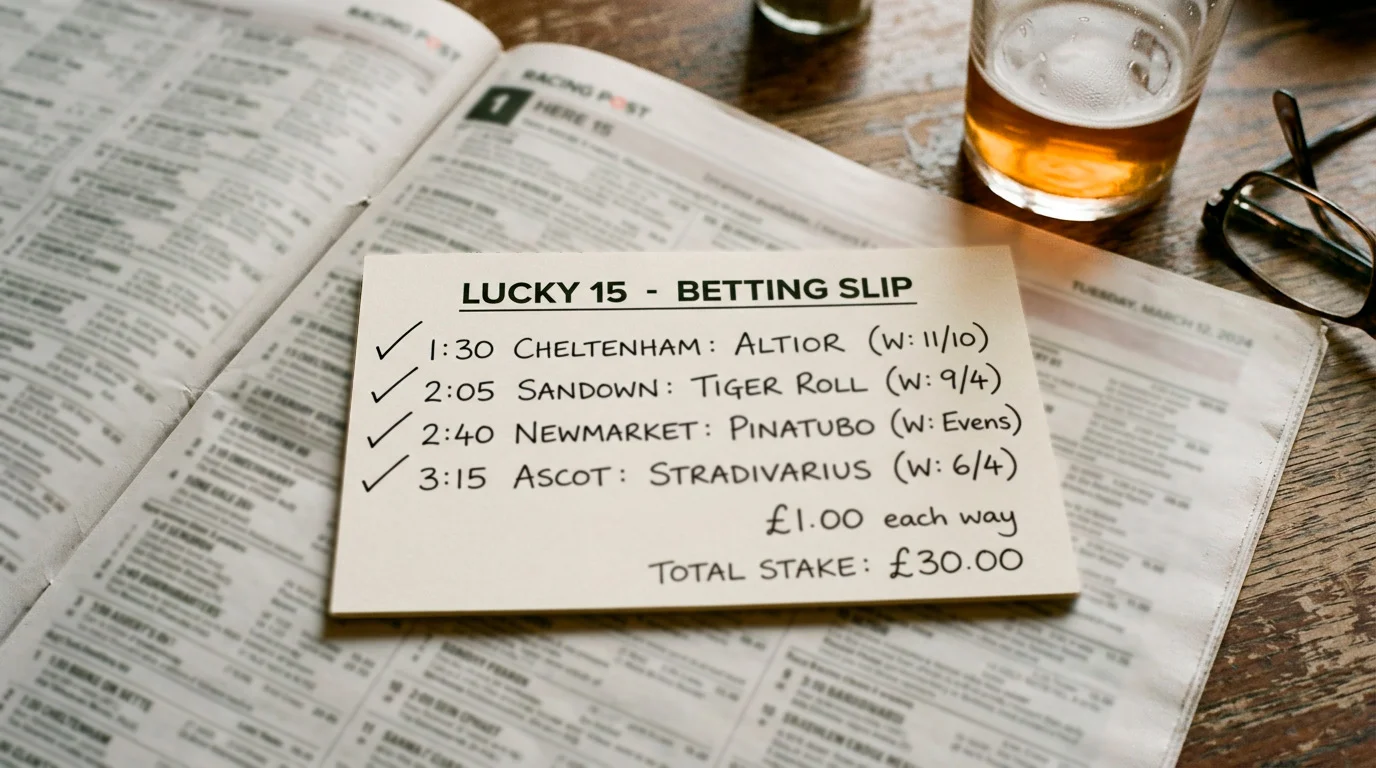
The Lucky 15 is a full-cover bet across four selections: four singles, six doubles, four trebles and one four-fold – 15 bets total at your chosen unit stake. A Lucky 15 on four 3-1 shots at £1 per line costs £15 and pays out on any combination of winners, with bigger returns the more selections land.
The Lucky 31 extends to five selections (31 bets: five singles, ten doubles, ten trebles, five four-folds, one five-fold). The Lucky 63 covers six selections in 63 bets. Beyond that, full-cover bets become commercially niche.
Most bookmakers offer enhanced terms on Lucky bets. A common enhancement: if only one selection wins, the single is paid at double or triple odds. If all selections win, a bonus of 10% or 20% is added to the total return. These enhancements genuinely move the maths. A Lucky 15 without enhancements is a losing bet on average. A Lucky 15 with double odds on a single winner and a 20% all-winners bonus can be close to break even in favourable conditions – usually when the selections are at prices around 3-1 to 5-1, long enough to benefit from the single-winner enhancement but short enough to give the all-winners four-fold a realistic shot.
The shape of the payout is what makes Lucky bets interesting. A flat four-fold either wins or loses – zero or the big return. A Lucky 15 covering the same four selections has 15 separate paths to returns, which smooths the variance compared to a single four-fold at the same total stake. You give up the biggest possible return in exchange for a less punitive loss distribution.
Acca insurance offers
Most major UK bookmakers offer some form of accumulator insurance: if all but one of your selections wins, your stake is refunded (as free bet tokens or cash). The specific terms vary widely – often limited to minimum five-folds at minimum combined odds, capped at certain stake amounts, and sometimes restricted to football rather than racing – but the concept is consistent across the industry.
The insurance offer genuinely changes accumulator expected value. A five-fold with one losing leg that would otherwise return zero becomes a stake refund, which mathematically is the same as converting some of the slip’s risk into a partial return. For a punter betting accumulators regularly, the difference between a bookmaker that offers insurance and one that does not can be the difference between a break-even approach and a losing one.
The catch is the bookmakers know this too. Insurance offers tend to be restricted to new customers, to specific sports, to specific market types, or to slips that meet tight qualifying conditions. Reading the terms carefully before committing is essential, and the refund is usually paid in free-bet tokens rather than withdrawable cash, which reduces the effective value. A free-bet token is worth roughly 70 to 80% of a cash equivalent, depending on how you use it.
Variance vs expected value
Accumulators are high-variance bets. A four-fold at four 3-1 selections pays roughly 255-1 if all four win and zero otherwise. The same four selections backed as four singles at the same stake pay smaller amounts each race but more reliably overall.
Long-run returns on the two approaches can be close when all individual bets are priced efficiently. What differs is the shape of the returns: singles produce steady small wins and losses, multiples produce long losing streaks punctuated by occasional large wins. If your bankroll cannot absorb a dozen consecutive losing multiples while waiting for the big one to land, accumulators will break you before the maths pays out.
The 33% Flat-favourite strike rate and the second-favourite strike rate of 19.4% (7,021 wins from 36,249 runs) illustrate the base rates. Stringing together selections at those strike rates compounds the losing probability fast: four 33% selections have roughly 1.2% combined chance of winning together; four 19.4% selections have 0.14%. A punter combining short-priced favourites in four-folds is betting on a 1-in-80 event even if the selections are correctly priced. That is not a “can’t miss” accumulator; that is a low-probability event packaged as an exciting bet slip.
Real world return examples
A practical framing helps. Say I construct a four-fold on today’s card: horses at 5-2, 3-1, 4-1 and 6-1. Combined decimal odds are 3.5 × 4.0 × 5.0 × 7.0 = 490 (so a 489-1 fractional return). A £5 stake returns £2,450 if all four win. The implied probability, assuming prices are fair, is 1 in 490, so the bookmaker’s expected hold on the slip is whatever margin the compounded overround produces – typically around 25 to 30% on a four-fold at these prices.
Over a year of betting similar four-folds, my actual return would average around 70 to 75p per £1 staked, with enormous variance week to week. Some months would show multi-thousand-pound returns; others would show nothing. Bankroll survival in that pattern requires either very small stakes or deep enough reserves to absorb many losing months.
With the UK horse racing remote betting market generating £766.7 million GGY in 2024-25 and average turnover per race down 8% year on year, bookmakers are under commercial pressure to promote the higher-margin accumulator markets. Expect to see more “enhanced acca” offers, more specials, more structured multiples – because those are the products where the bookmakers can rebuild margin against eroding single-bet turnover. That commercial pressure is visible in every weekend’s promotional page.
For the context of how multiples sit within the full range of UK racing wagers and where they earn their place, the pillar on betting at horse racing sets the landscape.
Articles
Published by the bettingathorseracing.com team.
