

The bet I kept coming back to
Nine years into serious UK racing betting, I keep being reminded that the best bet in my armoury is the one every newcomer learns on day one: the straight win. Each-way bets, forecasts, Placepots and exotic multiples all have their moments, but the win bet – one horse, one race, to win – remains the cleanest and most honest wager in the book. When I get it right, I win. When I get it wrong, I lose. No place-part cushion, no fractional returns, no perm arithmetic. Just the horse and the line.
The win bet is underrated precisely because it is simple. Punters looking for edge assume complexity must be part of the answer, so they drift into exotics and accumulators where the edges are harder to find and the variance is larger. Meanwhile the straight win bet, correctly staked on horses you have genuinely identified as underpriced, is the most reliable positive-expectation operation available to an informed UK punter.
How a win bet settles
A win bet pays out if, and only if, the horse you backed wins the race. First past the post, confirmed by the stewards. Anything else – second, third, photo finish you lose by a head – returns nothing. That binary outcome is what makes the win bet so clean and what makes it feel, to newcomers, more punitive than it really is.
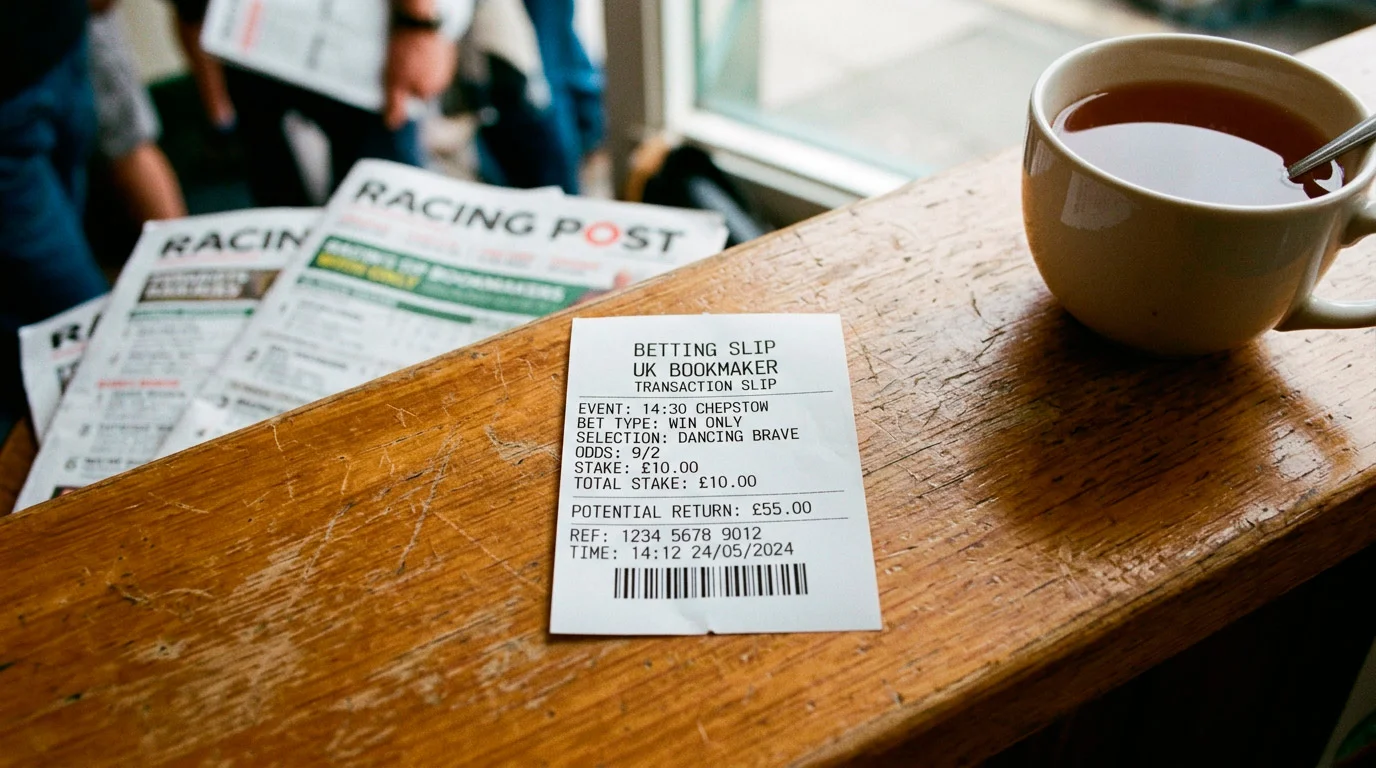
The stake returns at the price you took. A £10 bet at 5-1 returns £60 (£50 winnings plus £10 stake). A £10 bet at 15-8 returns £28.75. A £10 bet at 2-7 returns £12.86. The arithmetic is fractional odds converted to decimal, multiplied by stake. Most online bookmakers display both the fractional and decimal for every market, and the returns shown on the bet slip include the full payout rather than just the winnings.
Settlements apply Rule 4 deductions where horses have been withdrawn after your bet was placed, and Best Odds Guaranteed where the SP is longer than the price you took. Both mechanisms adjust the final return from the face-value calculation, and both can catch newer punters out when the slip pays less or more than the basic arithmetic suggested.
Win bet vs pool win
The fixed-odds win market and the Tote Win pool are different products competing for the same bet. The fixed-odds win gives you a price at the moment you place your bet; the Tote Win gives you a dividend calculated after the race from the pool’s total stakes minus takeout.
On competitive Saturday races with deep liquidity, the fixed-odds market usually prices the favourite efficiently. Tote Win on the same horse often pays less than SP because public money concentrates on the favourite, collapsing the dividend. On outsiders, the pattern can reverse – a 20-1 winner in a small field with most pool money on the favourite can pay a Tote dividend well above SP.
The 33% Flat-favourite strike rate is the reference number. A punter backing only favourites at level stakes through a full Flat season in the fixed-odds market at average prices loses money slowly. The same punter backing only favourites in the Tote Win pool loses faster, because the pool’s concentration on favourites drags the dividend below SP. Flat favourites are generally a worse Tote bet than they are a fixed-odds bet.
Photo finish and dead heat
Photo finishes happen often enough that every regular punter will be on one before the end of their first full season. The procedure is simple: the stewards call the result after reviewing the photo, which is usually a matter of seconds on modern systems. If your horse is first, the win bet pays at your taken odds. If it is second, the bet loses.
Dead heats – where two or more horses are judged to have crossed the line together – are rarer but not negligible. In a two-way dead heat, the win part of your bet is paid at half the normal return. A £10 win bet at 4-1 would normally return £50; in a two-way dead heat it returns £25 (half the £40 winnings plus the £10 stake). A three-way dead heat pays at a third. The stake is always returned in full; it is only the winnings that get halved or divided.
The dead-heat rule can surprise punters who have never seen one. It feels unfair to have “won” but collected half. The logic is that in a dead heat the bookmaker is paying out on two winning horses and splits the relevant pool between them. From the bookmaker’s perspective it is cleaner than it feels from the punter’s.
When win only beats each way
Every punter eventually faces the choice: back this horse to win, or back it each way? The maths is not complicated once you accept that each-way is two separate bets – a win bet and a place bet – and total returns depend on whether the horse wins, places, or finishes out of the places.
For short-priced horses, win only almost always beats each way. At 2-1 each way, you need the horse to win to show any profit at all on the combined bet, because the place-part odds at a quarter of 2-1 (so 1-2) barely cover the place stake. Betting 2-1 each way is essentially doubling your stake for negligible downside protection.
At longer prices the calculation shifts. Backing 10-1 each way genuinely protects you: if the horse places fourth, you recover the place-part return at one-fifth of 10-1 (so 2-1) on half your stake. The break-even threshold for each-way versus win-only varies by place terms, but as a rough rule of thumb, each way makes statistical sense from about 6-1 upwards, and clearly wins from 10-1. Below 6-1, win only is the cleaner bet.
The odds-on numbers reinforce the point. UK flat racing odds-on favourites win 55 to 60% of their races, with those priced at 1.25 or shorter landing 86% of the time. On an odds-on horse there is no each-way bet – the place terms make the place part essentially valueless – so the only question is whether the win price compensates for the risk. That decision belongs to win-only territory.
Bankroll for win punters
Andrew Rhodes, during his time as Chief Executive of the UK Gambling Commission, noted in 2022 that “a number of the largest operator groups – some sat in this room – are stating revenues are down due to safer gambling measures they are introducing in terms of stake limits and affordability measures they have taken.” The shift he described has intensified since: deposit thresholds for affordability checks have tightened from £500 monthly in August 2024 to £150 by February 2025, and stake caps have become routine on many regulated platforms. Punters operating under those constraints need to think harder than ever about how they allocate bankroll.
The straight win bet produces higher variance than each way on the same selection. A season of win-only betting can produce stretches of 15 or 20 losing bets in succession, even on correctly priced selections, simply because no selection wins better than about one-third of the time at best. Bankroll management has to assume those stretches will arrive.
My working rule is a 2% stake on any single win bet, reviewed monthly. Any single horse, however confident I feel, gets 2% of the current bankroll. A losing run draws the bankroll down and automatically reduces future stake sizes; a winning run grows it and scales stakes up without changing the percentage. That discipline is what keeps a winning win-only approach solvent through the inevitable variance. It is also what separates serious players from those who increase stakes after losses trying to “catch up” – the quickest route to a broken bankroll I know.
For the wider context of how win bets sit alongside other UK racing wagers, the pillar on betting at horse racing is the starting point.
Articles
Written by the editors at bettingathorseracing.com.
