

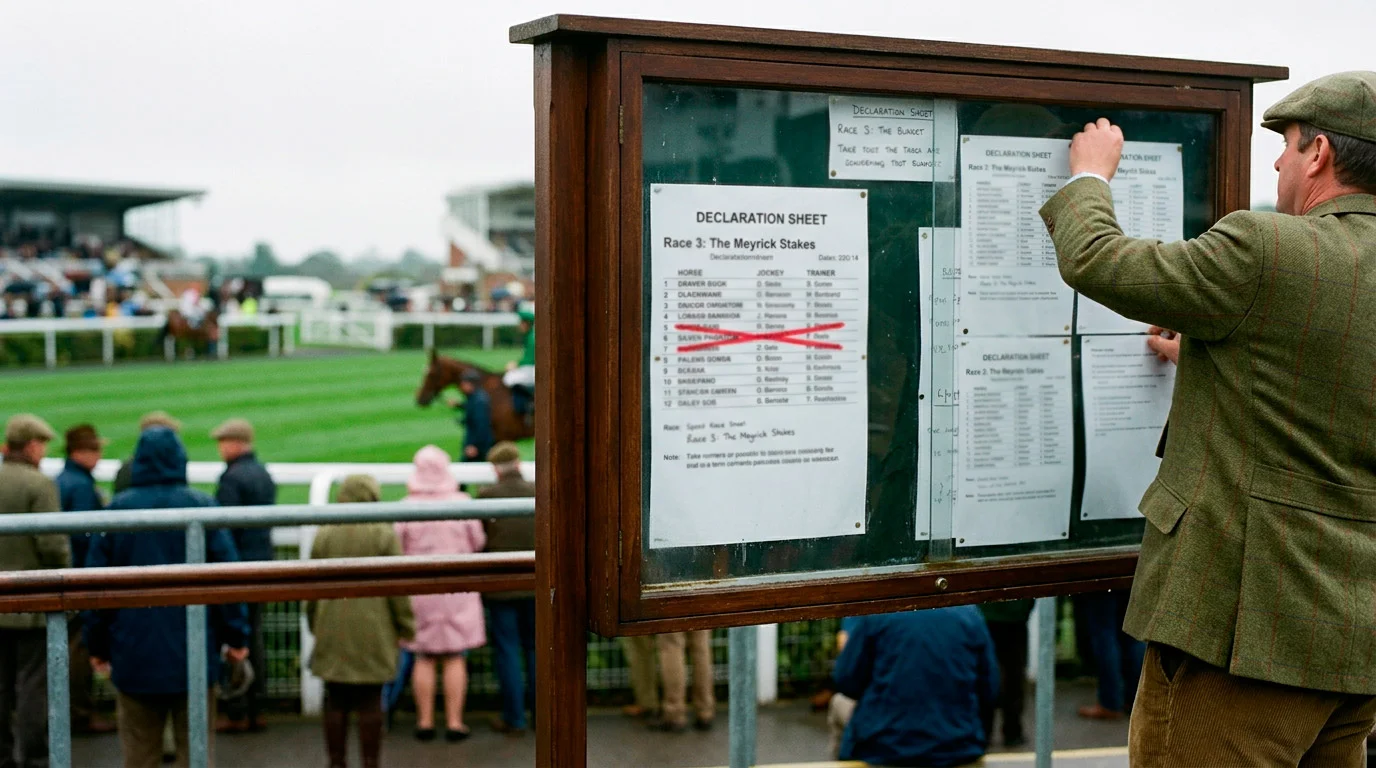
The deduction nobody warns you about
Ten years ago I cashed a winning slip at a Ladbrokes counter and the woman behind the glass handed me £58 instead of the £70 I had expected. I pointed at the slip. She pointed at the screen. “Rule 4, love. Twenty pence in the pound.” I had no idea what she was talking about, and the maths seemed wrong, and I walked out three quid lighter than I thought I should be because I did not know how to argue. The lesson cost me a week of reading.
Rule 4 is the most common deduction applied to winning UK racing bets, and it is also the most widely misunderstood. It shows up without warning, reshapes returns on winning slips, and interacts with other concessions in ways that confuse even experienced punters. This piece exists to make Rule 4 transparent, because if you are betting UK racing at any volume, you are going to hit it sooner rather than later.
Why Rule 4 exists
Rule 4 is named after clause 4(c) in the Tattersalls Rules on Betting, the industry rulebook that sits underneath every UK bookmaker’s terms and conditions. The problem it solves is simple. You place a bet on Horse A at 4-1. Horse B, second favourite in the same race at 3-1, is then withdrawn for any reason – refusing to load, injury on the way to post, veterinary decision – after the market has been made.
Horse A’s chance of winning is now structurally better than it was when you took the 4-1. A substantial rival has left the field. If the bookmaker paid you out at 4-1 when Horse A went on to win, they would be paying a price that reflected a race that never actually happened. Rule 4 is the bookmaker’s tool for adjusting winning returns to account for that change.
The deduction is applied as pence in the pound from the winnings, not from the stake. The scale is set by the withdrawn horse’s price at the moment of withdrawal, and it runs from a 90p-in-the-pound deduction at the extreme (withdrawn horse odds-on) down to no deduction at all (withdrawn horse at 14-1 or longer). In practice most withdrawals trigger deductions between 5p and 30p in the pound, which feels small until you see it applied to a £500 winning return.
The Tattersalls scale
The scale itself is published by Tattersalls and adopted across the UK bookmaking industry. The odds bands and deductions are not arbitrary; they reflect the withdrawn horse’s implied probability of winning, smoothed into practical pence-in-the-pound values.
At the short end, a withdrawn horse at 2-5 or shorter – odds-on at 30% or more implied chance – triggers a 90p-in-the-pound deduction. A withdrawn horse at 4-9 to 1-2 triggers 75p. A 4-7 to 4-6 withdrawal is 70p. From 8-13 to 4-5 is 65p; 5-6 to 5-4 is 55p; 11-8 to 6-4 is 45p.
From there the scale steps down more gently. 13-8 to 7-4 produces a 40p deduction. 15-8 to 9-4 is 35p. 5-2 to 3-1 is 30p. 10-3 to 4-1 is 25p. 9-2 to 11-2 is 20p. 6-1 to 9-1 is 10p. 10-1 to 14-1 is 5p. Anything longer than 14-1 produces no deduction, because the withdrawn horse’s chance of winning was considered negligible.
The practical implication is that the headline rate matters, but the combined rate matters more when multiple horses withdraw. If two horses in the same race come out, the deductions are added up to a maximum of 90p in the pound. A 30p deduction plus a 25p deduction produces a 55p-in-the-pound total – more than half your winnings gone. That is rare but it happens, usually in ante-post markets on big jumps races where non-runners accumulate.
Worked examples
Say you back Horse A at 4-1 to a £20 stake, and a single rival at 11-4 is withdrawn after the market has been priced. The scale triggers a 25p-in-the-pound deduction on winnings. Horse A wins. Your winnings are £80 (£20 × 4), but 25p in the pound is subtracted: £80 × 0.25 = £20 deduction. Your net winnings become £60. Add back your stake and the total return is £80.
Now say the same race sees two withdrawals, the 11-4 and a 7-1. The 11-4 triggers 25p, the 7-1 triggers 10p, combined deduction 35p in the pound. Horse A still wins at 4-1 to your £20 stake. Winnings £80, deduction £80 × 0.35 = £28. Net winnings £52, total return £72.
Consider a bigger-priced winner. You back Horse C at 10-1 to a £10 stake, and the 6-4 market favourite is withdrawn. The 6-4 triggers 45p-in-the-pound. Horse C wins: winnings £100, deduction £100 × 0.45 = £45. Net winnings £55, total return £65.
Each-way bets apply Rule 4 to both parts of the wager. A £10 each-way on Horse A at 10-1 with a 25p deduction has its win winnings reduced by 25%, and the place winnings (typically paid at a fraction of the win odds) are also reduced by 25%. The calculation is mechanical but the final figure often surprises punters who have not modelled it out in advance.
Interaction with NRNB and BOG
Rule 4 behaves differently in markets with specific bookmaker concessions, and the interactions are where most punters get confused.
Non-Runner No Bet is the most important concession to understand here. NRNB guarantees that if your horse does not run, your stake is returned. What NRNB does not do is protect you from Rule 4 deductions when other horses in the race are withdrawn. If you back Horse A at 4-1 with NRNB, and Horse B (a rival) is withdrawn, Rule 4 still applies to your return on Horse A. NRNB protects your stake if your horse comes out. It does not protect your winnings if a rival comes out.
Best Odds Guaranteed is the other interaction. BOG pays you the bigger of your taken price and the eventual Starting Price. Rule 4 applies to the actual winning return, whichever price is used. If you took 4-1, the SP was 5-1, and a withdrawal triggers a 20p Rule 4, BOG pays out at 5-1 and Rule 4 deducts 20p from those winnings. The two concessions stack: BOG lifts you to the bigger price first, then Rule 4 comes off the resulting winnings.
Ante-post markets work differently again. An ante-post bet on a race weeks away is taken at an early price with the understanding that if your horse does not run, your stake is lost. But Rule 4 on ante-post withdrawals is usually waived, because the early market is priced to assume non-runners will appear between the ante-post bet and the race. Race-day withdrawals from a race you have bet ante-post still trigger Rule 4 at the standard rate. The distinction matters and is worth checking in the specific bookmaker’s terms.
The wider UK horse racing remote-betting market generated £766.7 million in GGY in the 2024-25 financial year. That pool contains a staggering volume of slips whose returns were shaped by Rule 4 deductions the punter never fully understood. If you are operating inside that market, understanding how deductions interact with the concessions your bookmaker offers is not optional.
What settlement actually looks like
Settlement on modern online slips happens automatically, and the deduction appears in the bet history as a numeric line rather than a separate notice. On high-street slips the cashier applies the deduction at the counter. In both cases the punter has the right to see the applied rate and the withdrawn horse’s price at the moment of withdrawal; the bookmaker’s terms typically confirm the scale.
The point at which Rule 4 is applied – and the price of the withdrawn horse at that moment – matters. A horse withdrawn at 2-1 might have been priced at 6-1 earlier in the day; the deduction reflects the price when the horse came out, not the opening line. Bookmakers occasionally differ at the margins in how they apply the scale – some round up, some round down, some apply slightly different interpretations on multiple withdrawals – and disputed settlements go to the Independent Betting Adjudication Service.
A useful reference point comes from the Horserace Betting Levy Board’s recent commentary on yield variability. As its Chief Executive Alan Delmonte noted in the 2024-25 annual report, “The last two months, February and March 2025, saw bookmakers’ gross profits well above recent norms, with March’s outturn reflecting particularly bookmaker-friendly results at the Cheltenham Festival.” Festival weeks produce high withdrawal activity – declarations, going changes, veterinary issues – and the Rule 4 deductions associated with those withdrawals are part of what gives the bookmakers their March uplift. The same volatility note applies to turnover: betting turnover per race was down roughly 8% year-on-year in 2024-25, and Rule 4 settlements are one of the many small frictions that shape that number.
The practical takeaway for the punter is simple. Before celebrating a winning slip, check whether any withdrawals happened after your bet was struck and factor in the likely deduction. On ante-post bets leading into big festivals, expect Rule 4 activity routinely; on short-field weekday cards, rarely. For the wider context of how concessions and deductions interact with the markets you are betting into, the pillar on betting at horse racing is the reference.
Articles
Written by the editors at bettingathorseracing.com.
