

The only betting product that actually competes with fixed odds
The first time I won a Placepot I was 22 years old and had no business being in the Guinness Village at Cheltenham. Six races, six horses placed, a £1 unit stake returning £187. My mistake that afternoon was spending the lot on the train home. Nine years on I run Placepots to a plan, and I still think pool betting is the most misunderstood product in British racing.
Pool betting – the Tote’s family of wagers – is not a gimmick. It is the oldest continuously operating betting product in the country, predating the modern bookmaking industry by decades, and for certain bet types it delivers better dividends than fixed odds will ever match. The problem is almost nobody teaches it properly. Most guides treat Placepot as a novelty and Scoop 6 as a lottery. Both are wrong. This piece takes the three products that still matter – the win pool, the Placepot and Scoop 6 – and shows where they earn against SP and where they do not.
How pool betting differs
The easiest way to understand the Tote is to forget everything you know about bookmakers. A bookmaker sets a price, accepts your stake, and keeps the difference between what they owe you and what the race actually costs them. They carry the risk. The Tote does not work that way.
When you bet into a Tote pool, your stake joins every other stake on the same race into a common fund. When the race is settled, the Tote takes its cut – the “takeout” – and divides what remains among the winning ticket-holders. There is no fixed price. The dividend is whatever the maths produces after the race. If everyone backed the same horse, the dividend would be small. If most of the pool was on horses that lost, the dividend on the winner can be enormous.
That single structural difference changes everything. You are not betting against the Tote; you are betting against everyone else in the pool. Value in Tote betting is not about finding the horse that is mispriced on the board. It is about finding the horse that the rest of the pool has under-bet relative to its true chance. When a pool is dominated by casual money backing names and colours, a disciplined punter focused on form can find real edge.
The takeout varies by bet type. Tote Win and Tote Place takeouts in the UK sit in the 16 to 19% range. That is brutal compared to a sharp book’s implied overround on a big race, and it is why the Tote win pool is usually a bad place to bet straight winners. Where pool betting earns its keep is in the exotic pools – Placepot, Scoop 6, Jackpot – where the takeout is offset by far larger dividends when the pool rolls over or when a combination of outsiders comes in.
Placepot step by step
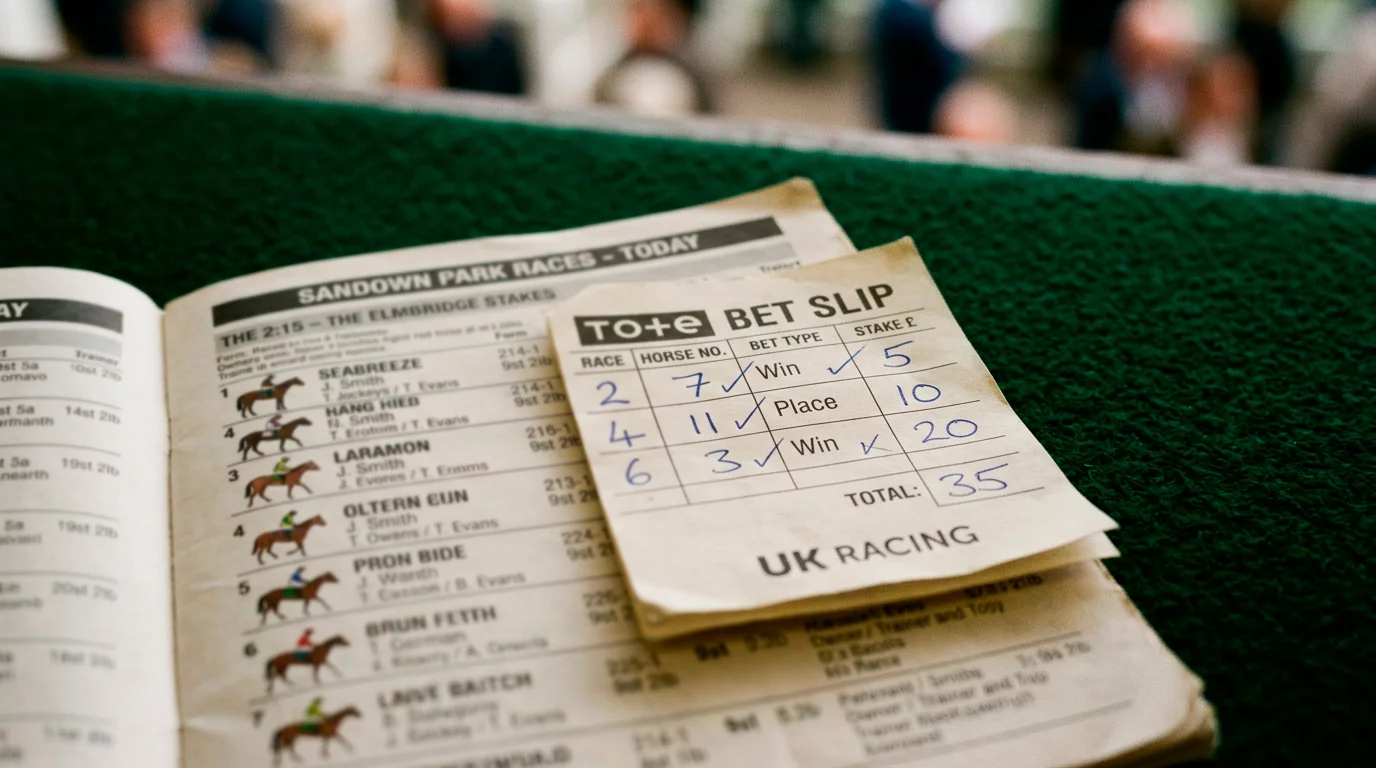
Start with one stake – as little as 10p – and one decision per race. Pick one horse, or several, to be placed in each of the first six races at a designated meeting. If your selections all place, you win a share of the pool. If one fails to place, the ticket dies.
“Placed” in Placepot terms means finishing in the places as defined by Tote rules for that race: the winner in a field of up to four runners, top two in five to seven runners, top three in eight or more. The field size at the meeting decides the terms at each leg, and small fields – common on midweek cards – make the ticket easier but also deflate the dividend.
The practical mechanics are where punters either make money or pour money in. If you pick one horse per race and they all place, you have a “straight” ticket at a minimum 10p unit stake. But most punters play “perms” – picking two or three horses in some races, sometimes banking a single pick in races they are confident about. Three-two-two-three-two-three translates to 3×2×2×3×2×3 = 216 combinations, so a 10p unit stake costs £21.60. The more you perm, the better your strike rate; also, the more you spend, and the smaller your proportional share of the eventual dividend.
My rule is simple: bank one or two races, perm the three or four I am unsure about, and never go above 200 lines on a weekday card or 500 on a festival card. Anything beyond that starts to feel like I am buying the dividend rather than earning it. The strike rate on a well-constructed ticket over a season runs around one successful ticket in seven, and the average winning dividend on British Placepots comfortably beats equivalent fixed-odds multiples for the same picks when you factor in the place terms.
Scoop 6 structure
Scoop 6 is the headline Tote product and the one that fills tabloid back pages when it rolls over. It runs on Saturdays. You pick the winner of six designated televised races. If all six come in, you share a Win Fund that frequently rolls into six-figure territory, and you also enter the Bonus Fund round the following week with your winning horse to try for a seven-figure jackpot.
The minimum unit stake is £2, and tickets are usually permed. Picking one horse in each of six competitive Saturday races is theoretically possible but statistically brutal – even six even-money favourites compound to odds of about 63-to-1, and Saturday Scoop 6 races are rarely six even-money shots. Realistic tickets run to 32, 64, 128 lines, costing £64, £128, £256 at minimum stake.
The product’s economics are interesting. Because it needs six winners from six specific races, the pool frequently rolls over – nobody picks all six – and the accumulated fund grows. A Scoop 6 week with a £1 million-plus guaranteed pool on offer will attract tourist money from casual punters who do not normally bet racing, which is exactly what the serious Scoop 6 player is hoping for. Casual money backs names. Informed money backs form. A well-constructed 96-line ticket on a rollover week can represent real value, particularly if two of the six races look open enough that the public will scatter their picks.
What Scoop 6 is not is a regular bet. It is a once-a-week, sometimes once-a-month discipline, and the right frame of mind is long-term. In a year of serious Scoop 6 play, a punter might land one major dividend and break even or lose slightly on the rest. That is how the maths shakes out, and anyone pitching it as a consistent income stream has not done the arithmetic.
Dividend vs SP comparison
The single most useful number in Tote betting is the comparison between the Tote Win dividend and the Starting Price. If the Tote pays more than the board price, you have a pool that undervalued your horse. If the Tote pays less, you should have bet the board.
In practice Tote Win dividends beat SP about a quarter of the time on competitive Saturday handicaps, rarely on short-priced favourites, and almost always on outsiders in small fields with casual-money distortion. The pattern is driven by the 33% Flat-favourite strike rate: the pool tends to pile onto the favourite, which collapses the dividend on the favourite while leaving the second and third favourites underpriced relative to the board.
Tote Place – a separate pool paying on a horse finishing in the places – works similarly but with even more distortion. Place money on the favourite is often worse than SP Place terms offered by any bookmaker with extra places running. Place money on an outsider can occasionally pay double what the board pays. The lesson: check the Tote dividend history for the meeting you are betting before committing. If the meeting has a pattern of skinny Tote dividends, take the board price; if outsiders have been paying well, the pool is a candidate.
When pool beats fixed odds
Pool wins fixed odds in three specific scenarios. First, when a rank outsider runs well against heavy favourite money – the Tote dividend can dwarf SP on winners and places. Second, when the race is low-grade and small-field but the pool is fed by a larger meeting’s total pool – the economics sometimes produce dividends that no bookmaker would offer. Third, when the tourist-money effect on Saturday Scoop 6 or festival Placepot pools overweights obvious names and leaves less-obvious form horses effectively under-priced.
Flat racing’s 55 to 60% strike rate on odds-on favourites, and the headline 86% win rate at 1.25 or shorter, mean that in any pool with heavy odds-on money on the favourite, the dividend on that horse is going to collapse. Pool betting earns by avoiding those horses unless they are genuine exceptions. The punter who uses the pool to back the second favourite – 19.4% strike rate, level-stakes loss of 11.8% – is betting into a product where the dividend often exceeds the SP on the same horse, and that takes the long-run level-stakes loss closer to break even than a bookmaker’s board will ever do.
None of this is an argument to bet only the Tote. The right use of pool betting sits alongside fixed-odds betting as a separate discipline, with its own analysis and its own stake sizing. On a sharp card with big fields and plenty of casual money in the pool, a disciplined Placepot or a well-constructed Scoop 6 ticket earns its place in the week’s activity. On quiet midweek cards the pools are thin and fixed odds win every time. Knowing which is which is the skill. For the broader context of how pool products fit into the UK betting landscape, the pillar on betting at horse racing is the starting point.
Articles
Written by the editors at bettingathorseracing.com.
