

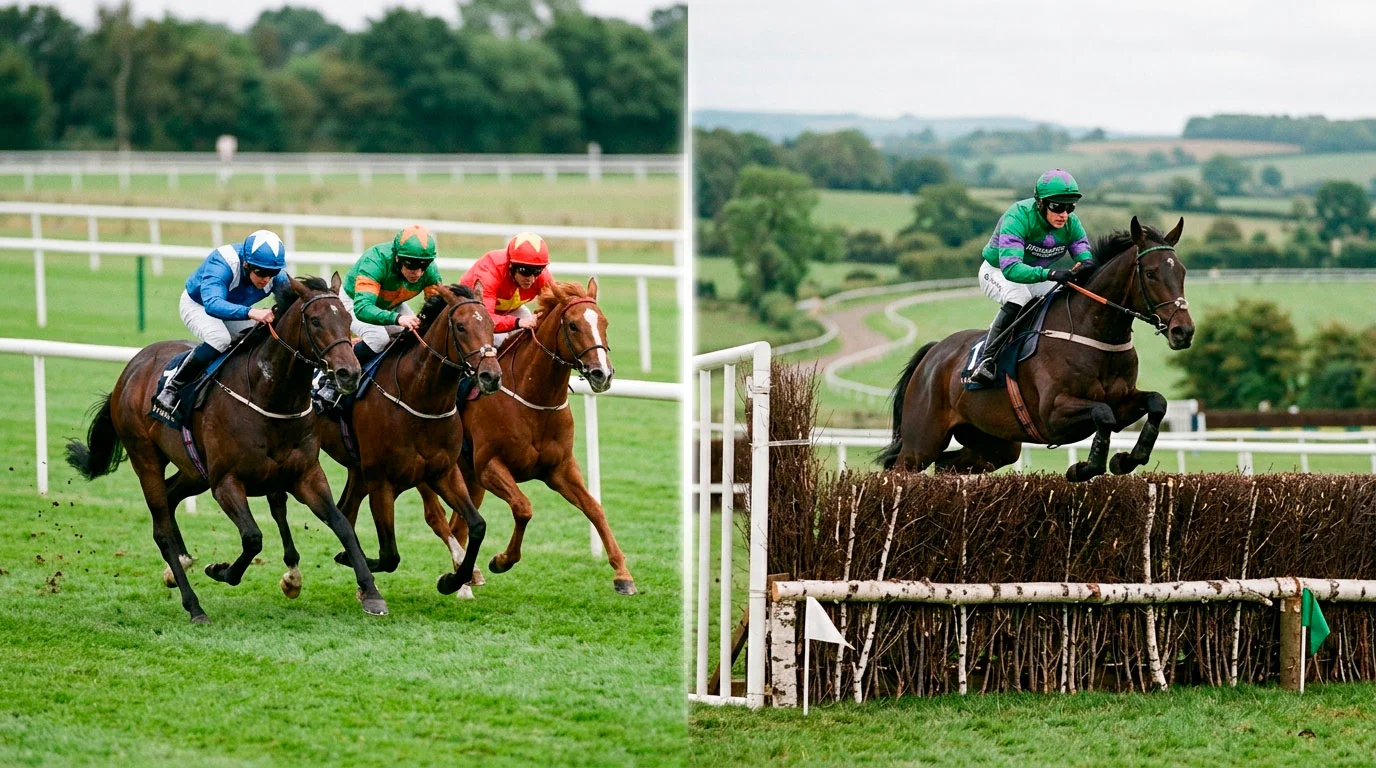
Two sports pretending to be one
A friend of mine, perfectly intelligent, told me last summer he had “backed a horse at Cheltenham” in July. There is no racing at Cheltenham in July. He had, in fact, backed a Flat handicapper at Newmarket and confused himself somewhere along the way. The mistake is more common than the industry likes to admit, because we act as though horse racing is one sport when it is two, and the punters who never learn the difference end up wagering into markets they do not understand.
Flat and National Hunt share a landscape and a language. They share the bookmakers, the broadcasters, the racecard layouts, the terminology. But as products to bet on they behave differently, because the horses are different, the seasons are different, the race types are different and – crucially – the market pricing and favourite reliability are different too. If you are reading about Ryan Moore riding a Group 1 at Ascot one week and Rachael Blackmore winning over fences the next and treating them as adjacent events, you are missing the shape of the sport.
Flat season and distances
The British Flat turf season opens at Doncaster in late March and closes at the same course in early November. Inside that window the sport is about speed, precocity and pedigree. Distances run from five-furlong sprints – roughly 1,000 metres, over in under a minute – to the two-and-a-half mile Gold Cup at Royal Ascot. The bulk of races sit between six furlongs and a mile and a half, and the classics (2,000 Guineas, Oaks, Derby, St Leger) define the season’s rhythm.
The horses themselves are young. Two-year-olds race only on the Flat and form the entire first half of the season’s novice action. Three-year-olds dominate the classic window. By the age of five or six most Flat horses have either retired to stud, moved to jumps, or slipped down the handicap into the ordinary weekday cards. That short career shape is baked into the betting: form figures age quickly, trainers’ plans are tightly structured around target races, and the ratings ladder moves briskly as horses improve or go the other way.
The quality at the top is holding. In 2025 Britain fielded 1,423 Flat runners rated 90 or higher – essentially flat versus the 1,398 recorded in 2024, which suggests the elite pool has not thinned despite the turnover pressure below. That matters for the punter because Group-race and high-class handicap fields remain deep, and the markets at Ascot, Goodwood and York stay competitive even as lower-grade cards struggle.
All-weather racing is Flat racing too, and it runs year-round. Kempton, Lingfield, Wolverhampton, Newcastle, Chelmsford and Southwell host the bulk of it on polytrack or tapeta surfaces. All-weather is often dismissed as lower-quality, and the strongest Group races really are on turf, but all-weather form translates reliably into turf form on soft-to-good ground. Ignoring it in your reading means ignoring roughly a third of the British calendar.
National Hunt season
Jumps racing sprawls where the Flat is tidy. The National Hunt season does not really start or stop; British yards are running over jumps somewhere every month of the year, though the core runs from October through to the Grand National meeting at Aintree in April. The Festival at Cheltenham in March is the commercial and sporting apex.
Where Flat is about speed and youth, jumps is about stamina, jumping technique and seasoned campaigners. A horse is considered young at four or five. The greats – Kauto Star, Big Buck’s, Denman, more recently Constitution Hill and Galopin Des Champs – often hit their peak between seven and ten. Careers over jumps run for years rather than seasons, because the horses are allowed to mature into the work.
The sport splits into hurdles (smaller obstacles, usually faster races) and chases (fences, usually longer, more attritional). Bumper races – National Hunt flat races – exist as nursery events for horses who will later move to hurdles and then chases. Novice, handicap and conditions races exist in both hurdles and chases. A novice hurdle at Wincanton is a completely different proposition to a Class 2 handicap chase at Newbury, and the form figures reflect that.
The quality end is smaller and tighter than the Flat. In 2025 Britain had 489 Jump runners rated 135 or higher, essentially level with the 490 of 2024. That is a pool about a third the size of the top-end Flat population. What it means in practice is that the top jumps races run through a relatively small and familiar cast of horses and yards. Punters who follow the sport closely know those names.
Betting differences between codes
Here is where casual punters get caught. Flat and National Hunt do not price the same way, and the concessions attached to each code differ in practical importance.
On the Flat, races are usually over inside two minutes and the outcome is often determined in the final furlong. Variance is high, margins are tight, and the market tends to price favourites efficiently. Photo finishes are common, dead heats happen more often than most punters realise, and a single length at the line separates winning and losing bets constantly.
Jumps racing is longer and messier. A two-mile hurdle takes about four minutes; a three-and-a-half-mile chase can take over seven. Horses can fall, unseat, be brought down or simply run out of petrol. That injects non-price risk the Flat does not carry, which is why Non-Runner No Bet concessions become materially more valuable on big jumps cards: the Grand National field in 2026 is capped at 34 runners after being cut from the old 40, and declarations shift right up to the morning of the race.
Each-way terms also behave differently across the codes. Most Flat handicaps in full fields pay four or five places; jumps races outside the biggest festivals typically pay three. The Grand National is the outlier that swings the annual market: the extra-places wars run by bookmakers around Aintree – six, seven, eight, sometimes ten places – are not mirrored on any Flat card all year. The mechanics of that trade-off matter because they change when each-way makes statistical sense and when it does not.
Favourite reliability by code
If I had to give one practical tip to a new punter, it would be this: do not assume favourites behave the same way over jumps as they do on the Flat. The strike rates are close on paper but the shape underneath is different.
On the Flat, favourites in British racing win roughly a third of races across a long sample – 33% is the standard number and it has been stable for years. Odds-on Flat favourites are more reliable still, winning 55 to 60% of the races they contest, and shortening to 1.25 or less (anything around 1/4) they win roughly 86% of the time.
Over jumps the headline 33% figure is similar, but the distribution of failures differs. Jumps favourites lose because horses fall or unseat, not only because they were wrongly priced. A Flat favourite beaten a length at 2-1 is a market judgement problem. A jumps favourite beaten after unseating at the second-last is bad luck, and that changes how you should bet the next time the same horse appears. Cheltenham in 2025 saw seven odds-on favourites sent off; five of them lost. The market had read the form correctly. Jumping – the actual physical act – had decided the races.
Second favourites tell an even more useful story. Across a large sample of UK racing, second favourites win 19.4% of races (7,021 wins from 36,249 runs) and show a level-stakes loss of around 11.8%. That is close to efficient but not quite: the market slightly overprices second favourites versus their true chance, probably because punters looking for “value” gravitate to them more than the numbers justify.
All-weather surfaces
The all-weather component of the Flat code deserves its own paragraph because it confuses newcomers more than it should. Britain has six all-weather tracks running throughout the year, and they provide the bulk of the winter Flat product while the turf courses are closed. The surfaces are engineered to drain and not freeze, which means meetings go ahead in weather that would wipe out turf.
All-weather form is not second-class form. A horse running well at Chelmsford in January will usually transfer that form to turf in April if the ground comes up soft. What all-weather does not price as richly is liquidity: midweek twilight meetings attract a fraction of the betting turnover a Saturday turf card pulls in, and that thin liquidity can mean wider margins and less reliable SP formation. Punters willing to work midweek all-weather cards often find value the main market does not bother to squeeze out.
Economic scale
The two codes do not contribute equally to the sport’s economics. Flat racing generates more attendance and more headline Group-race prize money; National Hunt generates the betting turnover spikes that define the year. The Grand National alone attracts roughly seven times the money wagered on the Cheltenham Gold Cup, and jumps racing’s two flagship weeks – Cheltenham in March and Aintree in April – carry disproportionate weight in the annual GGY figures. As the British Horseracing Authority has put it in its parliamentary submissions, horse racing’s direct revenues are in excess of £1.47 billion and its total annual contribution to the UK economy is around £4.1 billion, and those numbers rest on both codes working in concert.
For the punter, the practical implication is that jumps season – October through April – is when the crowds, the coverage and the concessions are at their most generous. Flat season – March through November – is when the quality at the top is at its sharpest and the pricing at the elite end is tightest. Knowing which code you are betting is the first step. The pillar on betting at horse racing covers the wider landscape both codes sit inside.
Articles
Published by the bettingathorseracing.com team.
