

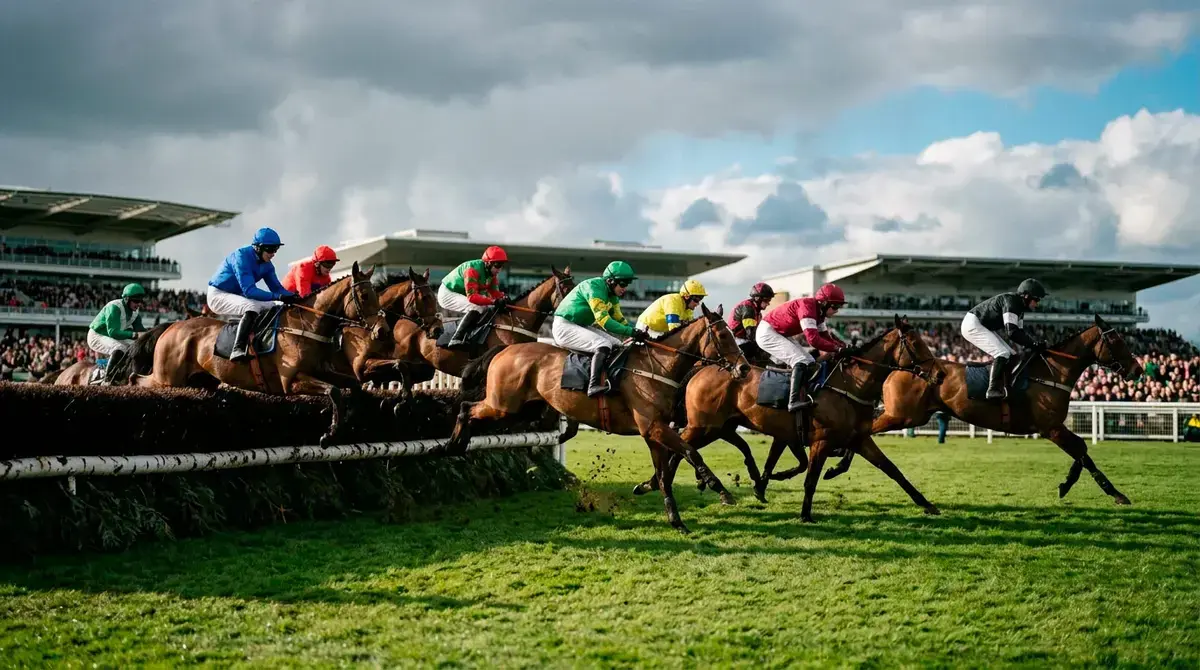
The one day of the year when my nan rings me about a horse
Every spring, within twenty-four hours of the Grand National weights being announced, I get a phone call from my grandmother in Wigan who has not watched a single race for eleven and a half months. She wants a tip. Specifically, she wants a tip that has a nice name, preferably wearing green, and is what she calls “a decent price.” She is not alone. About two hundred and fifty million pounds was staked on the 2025 Grand National — seven hundred per cent more than flowed through the books on the Cheltenham Gold Cup the same year — and a vast share of that money came from people who never set foot in a bookmaker’s shop between Aintree meetings. Entain’s data confirmed the race was the single biggest gambling event in the UK for the second year running, ahead of the FA Cup Final and the Super Bowl.
What this tells you, if you are a regular punter, is that the Grand National is not a normal race to price or to bet. The weight of casual money distorts the market. The sheer size of the field — now capped at thirty-four runners since the 2024 safety review — distorts the probability distribution. The format of the race, four and a quarter miles over thirty fences at Aintree, distorts what makes a good horse. And the stakes involved, with a one-million-pound prize fund and five hundred thousand for first place in 2026, distort the behaviour of connections in ways that are quietly visible in the entries and withdrawals.
I am going to walk you through how the Grand National market actually behaves — from the weights publication in February through race day in April — and show you where the smart money finds its edges, where the casual money piles into traps, and how to size a bet sensibly for a race where the variance is genuinely enormous.
Why the Grand National is not like any other race you will bet on
I was at Aintree in 2022, standing near the finish line, when Noble Yeats came up the run-in in front at 50/1. The horse was ridden by Sam Waley-Cohen, an amateur on his final ride before retirement, and until about the last six furlongs, approximately nobody in the grandstand had fancied it. The roar when he hit the front was one of the strangest sounds I have ever heard at a racecourse — half celebration, half disbelief. It was the loudest cheer for a horse nobody had backed.
That is the Grand National in one anecdote. A race where the probability of the pre-race favourite winning is closer to ten per cent than to the thirty-three per cent you get in a standard UK flat race. Where stamina, jumping ability, luck in running, weight carried, and the ground on the day all feed into a distribution that cannot be modelled with the confidence you would apply to a King George or a Champion Hurdle. Where 50/1 winners happen, 100/1 winners have happened, and the horses priced at 10/1 and shorter beforehand often finish well down the field.
Three structural features separate the race from everything else on the calendar. First, the distance. Four miles two and a half furlongs is a genuine stamina test, and the race is run over thirty fences that were redesigned in 2012 and again in 2024 to reduce casualties without removing the fundamental challenge. The fences are still bigger and stiffer than anything the horses will have met all season. A horse that jumps competently at Haydock or Cheltenham is not guaranteed to cope with The Chair, Becher’s Brook, or the Canal Turn at speed in a thirty-four-horse field.
Second, the field size. Thirty-four runners is the post-2024 cap, reduced from forty in the wake of the safety review. The field size still means that even a horse with a twenty-per-cent chance of winning on a stamina-and-ability basis faces severe interference, traffic problems, and jumping hazards that are substantially independent of its racing merit. Luck in running, a notoriously fuzzy concept in other races, is a genuine first-order variable at Aintree.
Third, the handicap structure. The Grand National is a handicap, meaning the weights are set by the BHA handicapper to give every horse an equal theoretical chance based on rating. In practice, the top-weighted horses (usually around eleven stone ten) carry so much lead that their stamina is tested to the limit, while the bottom weights (around ten stone) are carrying what are technically lighter burdens but are often lower-rated horses who simply do not have the class. The handicap flattens the field mathematically and then the race unflattens it brutally in practice.
What the thirty-four-runner field really means for your bet
The field structure of the 2026 Grand National will look broadly similar to the 2024 and 2025 editions. Thirty-four runners were confirmed as the maximum after the safety review, down from the forty that had been standard for decades, and the prize fund stands at one million pounds with five hundred thousand going to the winner. Entries to the race have themselves been trending downward — seventy-eight entries for the 2026 edition, compared to around one hundred and twenty-six a decade earlier, reflecting both the reduced field size and the changing economics of staying chasers in British and Irish yards.
The practical impact on your bet is threefold. Fewer entries mean a tighter weights band, because the handicapper has less room to manoeuvre between top and bottom. Fewer runners mean the probability of any specific horse being “the one” is structurally higher than in a forty-runner race — but the probability of a horse placing in the top five or six is lower, because there are fewer tickets in the hat overall. And the cap on runners means the connections of borderline horses have less reason to engage an Aintree campaign with a horse that may not get in, which changes the quality of the bottom of the field.
From a pricing perspective, the post-2024 Grand National has settled into a pattern where the favourite is typically priced in the 7/1 to 12/1 range (compared to 10/1 to 20/1 in the forty-runner era), the top five in the market cluster between 8/1 and 20/1, and outsiders at 33/1 and longer occupy more than half the field. The distribution has tightened at the top because the smaller field means fewer longshots in absolute numbers, but the skew is still severe enough that any horse priced 33/1 or shorter has at minimum a two-per-cent implied probability — which sounds absurd for a specific horse in any race until you remember what happened in 2022.
One under-appreciated consequence of the thirty-four cap is that the weights publication in February, usually around six weeks before the race, takes on a different significance than it used to. In the forty-runner era, connections of a rated-140-plus horse knew they were likely to get in and could plan accordingly. In the thirty-four-runner era, the cut-off has moved up the ratings ladder, which means a horse rated in the low 140s now faces genuine uncertainty about whether it makes the final field — and that uncertainty feeds directly into the ante-post prices you see between February and March.
Ante-post betting versus race-day betting — when each pays off
I have a spreadsheet on my laptop called “AP_GN_decisions” that I have maintained since 2015. It tracks every ante-post bet I have placed on the Grand National from weights day onwards, what price I got, what the closing price was, and what the SP was on race day. The headline number across ten years is that my average ante-post price is thirty-two per cent longer than the equivalent SP, but my strike rate is slightly lower because a handful of horses I have backed were either scratched before the race, fell at Becher’s on the first circuit, or were withdrawn with a recent training setback.
Ante-post on the Grand National is a distinctive product because the race is the rare handicap chase where connections actually commit to running unless something significant goes wrong. A horse entered at the five-day confirmation stage is almost certainly going to run, whereas an equivalent entry for a Cheltenham Festival novice hurdle is subject to far more late-race juggling. This means that the risk of a non-runner is lower on the Grand National than you might expect from a handicap of this size — though the risk is still non-trivial, and Non-Runner No Bet protections matter.
The phases of the market are worth knowing. From weights publication in February until about the end of March, prices move gradually as form develops in the Irish and British chases. You will see steamers emerge — horses whose prices shorten as the ante-post money comes in — and drifters, whose prices lengthen through neglect or trainer comment. The late March Cheltenham Festival itself often reshapes the Grand National market, because horses who ran at Prestbury Park four weeks before Aintree are either confirmed as genuine contenders or exposed as not quite good enough. The last week, from the five-day confirmations to race day, is where most casual punters engage, and it is also when the market tightens and concessions proliferate.
The sweet spot for ante-post, in my experience, is the period from late March (post-Cheltenham) to the five-day confirmations. At that point, the field is essentially known, your NRNB protections apply on most books, and the prices have not yet been compressed by the race-week media attention. An 18/1 chance on a well-weighted, well-trained, jumping horse at that stage is often 12/1 or 10/1 by race day — a meaningful overlay that rewards the punter who has done homework ahead of the crowd.
Race-day betting has its own advantages. By race morning, the form has crystallised, the ground conditions are known, and any late withdrawals have already happened so the field is stable. The concessions are at their most generous — enhanced place terms, BOG running into the race itself, and sometimes promotional multipliers — and the ability to shop across books gives you the best available price on almost any horse. The disadvantage is that the market is efficient by this point, and the prices reflect the consensus of informed money from a full morning of trading.
Enhanced place terms and the economics of extra places
Grand National promotions are the single most generous each-way product of the calendar year. Most operators offer four or five places at one-quarter odds as standard; many extend to six places, a few go to seven, and in peak promotional years I have seen offers of eight places on the race. Each additional paid place adds a materially different expected return to an each-way bet, because the probability mass of an outsider finishing sixth or seventh instead of the “standard” first-to-fourth window is meaningful.
The arithmetic is straightforward. A five-place each-way bet at 25/1 in a thirty-four-runner field wins the place part at one-quarter of 25/1 — so 6/1 on the place — if the horse finishes in the top five. The probability of a 25/1 horse finishing in the top five is roughly fifteen per cent, maybe a little higher on a generous day. An extension to six places raises that probability to perhaps seventeen per cent, and seven places to nineteen per cent. Each extra place is worth two or three percentage points of win probability on a mid-priced outsider, which over the full ticket translates to a thirty-to-forty per cent uplift in expected return on the place part of the each-way bet.
Where extra-place offers deliver the strongest value is on the outsiders — horses priced between 25/1 and 66/1 who have a genuine chance of running into the frame without being winners. Short-priced favourites gain less from extended places because they either win or finish close enough up to place under standard terms anyway. The extra places matter for horses whose finishing distribution is heavily weighted toward the middle of the field — a sound jumper with stamina who is simply not class enough to challenge the leaders, but good enough to stay on for fifth or sixth.
One caveat I give every casual punter who asks me about National bets. The extra places are generous, but they do not compensate for backing the wrong type of horse. A 50/1 outsider with suspect jumping and questionable stamina is still a 50/1 outsider even at six places at a quarter. The concession amplifies the value of a sound pick; it does not rescue a poor one.
Reading the weights and what the handicap actually tells you
The weights are published in February, usually in the second week, and from that moment onwards the shape of the race is effectively fixed. The handicapper has looked at every entered horse’s rating and assigned a weight between ten stone (for horses rated low) and eleven stone ten or thereabouts (for horses rated high), and the intention is to give every horse a theoretical equal chance on a sound surface at four and a quarter miles.
In practice, the top weights are carrying what I would call a punishing burden in a race of this distance. Anything carrying eleven stone seven or more is giving away a stone or more in weight to the bottom of the field, and over four and a quarter miles of stiff fences that stone matters more than it does in a shorter chase. Top-weighted horses have won the race — Many Clouds, Tiger Roll on his first win — but the historical strike rate of top-five weights is notably worse than their ratings would suggest.
Middle weights — between ten stone twelve and eleven stone five — have the best strike rate over the last two decades. These are horses with genuine Grade-Three-class ability but not so much class that they are penalised heavily, and they carry weights that are stamina-neutral at the Aintree distance. Rachael Blackmore’s Minella Times, Noble Yeats, Tiger Roll the second time, Many Clouds — most recent winners fall in this bracket.
Bottom weights — ten stone to ten stone eleven — are where the outsiders live, and the story is more nuanced. Many of them are simply not good enough, which is why they are priced at 40/1 and longer. But every year a bottom-weight comes through because the light burden preserves their stamina to the final fences, and they stay on when better-class horses in the middle of the race have wilted. The bottom-weight outsider is the classic Grand National “specky” pick — the horse that sneaks into the frame at a big price because the weights and distance have served them.
The structural signal to watch for is what I call the “over-weighted contender.” A horse rated 155 who gets in off ten stone twelve is carrying four pounds less than the handicapper wanted to give them, because they were at the wrong end of the weights table. That horse has a structural advantage — BHA-rated class comparable to the top weights, but carrying the lightness of a middle weight. These are the horses that price compilers respect but the public often overlooks, and they represent one of the genuine inefficiencies of the market.
The long-shot history and what a 50/1 winner actually requires
Noble Yeats in 2022 was the most recent 50/1 winner, and before him you go back to 2009’s Mon Mome (100/1) and 2009’s Auroras Encore territory for the really eyebrow-raising prices. Longshot winners are not random. Almost every one, when you look at the post-race analysis, shares a cluster of features: sound jumping history in good chases over three miles or further; a record of staying on rather than finishing fast; a trainer who has either won the race before or trained other stayers successfully; and a horse profile — often younger, occasionally lightly-raced — that the market has not priced for the exact conditions of Aintree day.
What makes a longshot genuinely backable is the confluence of stamina, jumping, and weight. Horses carrying ten stone seven or less, with a proven stamina profile (second or third in a three-mile-plus chase earlier in the season), jumping solidly in their last two or three runs, and trained by someone who has either won the race before or been placed in it, carry disproportionate value at prices of 33/1 and longer. They do not win often enough to be a single-bet proposition, but across the portfolio of a punter who takes five or six each-way wagers on the race, one of them will land once every three or four years at a price that pays for the losing tickets several times over.
The market, to its credit, has adapted. Prices on identifiable longshots of this profile have shortened noticeably over the last decade, from the 100/1 territory that Mon Mome returned at in 2009 to more typical 33/1 to 50/1 brackets today. This is partly because the exchange has priced these horses more efficiently, partly because the data available to casual punters has improved, and partly because the Grand National field has itself become smaller and higher-quality. But the structural opportunity for the 33/1 outsider with good form is still there if you know what you are looking for, and the each-way dividends from finishing third or fourth can cover a portfolio of five or six losing bets.
The economic footprint of one race and why racing watches Aintree closely
One of the quieter statistics about the Grand National is how much of the annual horse racing turnover the race represents. That two hundred and fifty million figure I mentioned at the top is, to put it in context, roughly a third of the entire annual remote betting GGY on UK horse racing, which came to seven hundred and sixty-six-point-seven million pounds in the 2024-25 financial year. A single race, a single afternoon, accounts for a third of the sport’s annual online betting economy. That is not a statistic any operator takes lightly.
The follow-on impacts are visible across the racing calendar. The Levy — Britain’s mandatory contribution from bookmakers to prize money, at ten per cent of annual gross profits above five hundred thousand pounds — depends materially on Grand National turnover for the Aintree month to hit its annual budget. Alan Delmonte, the Levy Board chief executive, noted in the 2024-25 HBLB Annual Report that “the last two months, February and March 2025, saw bookmakers’ gross profits well above recent norms, with March’s outturn reflecting particularly bookmaker-friendly results at the Cheltenham Festival.” The April numbers for the Grand National add a similar surge, though in a different direction — punter-friendly when a longshot lands, bookmaker-friendly when the favourite obliges.
Brant Dunshea, the BHA’s chief executive, put the wider economic case for racing succinctly in a Racing Post interview ahead of the 2025 season. He pointed out that racing is “the second most-attended sport, we employ people nationwide,” and warned about financial threats around the Levy and affordability checks. The Grand National sits at the heart of that economic case. If the race loses audience or turnover, the downstream effects on prize money funding, on the sustainability of mid-tier yards, on racecourse investment and on employment through the bloodstock chain are all material.
What this means for your bet is nothing direct. The maths of your wager is the same whether the race generates two hundred and fifty million or four hundred million in turnover. But understanding that the ecosystem around the race is under genuine financial pressure — see the wider UK horse racing context — explains why operators invest so heavily in promotional concessions on Aintree day, why the weights day and ante-post market are so actively traded, and why the professional punters who chase value on the Grand National watch the race with an intensity that is disproportionate to its single-day nature.
Sizing a Grand National bet for the casual who wants to actually enjoy the race
My grandmother, to return to her, does not want a detailed portfolio analysis. She wants to spend ten pounds, pick a horse with a good name, and watch the race with a drink and the possibility of forty pounds in her pocket if things go well. The mistake most casual punters make is over-committing — either by putting too much on a single horse, or by spreading so thinly across eight or nine selections that the variance of the race wipes out the entire stake.
For a ten-to-fifty pound budget, the sensible play is two or three each-way bets at prices between 16/1 and 33/1, on horses whose profile suits the race — sound jumping, proven stamina, light weight, respected trainer. Three five-pound each-way bets at 25/1 with five places at a quarter costs thirty pounds in total stake and returns around one hundred and sixty pounds if one of the three places, or seven hundred plus if one of them wins. The probability of at least one of three sensibly-chosen 20/1 to 33/1 horses placing in a five-place field is somewhere in the thirty-five to forty-five per cent range — better than a coin flip, and with an upside that pays for several losing Nationals.
For a larger budget, the logic gets more sophisticated but the principle is the same. Never commit more than ten per cent of your annual punting budget to a single Grand National. The variance is extreme. Even with a well-thought-through portfolio of six or eight each-way selections, the race can leave you with nothing, or can pay out at three or four times the total stake. Sizing to survive a year of no wins is the sensible approach. Casual punters who stake their “whole season” on the National, either because they have not budgeted or because the race feels exceptional, routinely end up in the red for the calendar year even when the rest of their betting is profitable.
One final note on the emotional side. The Grand National is a race where the story — the horse, the jockey, the connections, the back-story of the owner — matters more than in perhaps any other event. Backing a horse because the name appeals is not a statistically optimal strategy, but it is the reason millions of people bet on the race, and it is perfectly fine if you have budgeted the stake and are betting for enjoyment rather than expected value. Just do not tell yourself it is anything other than what it is.
Questions that come up every Aintree weekend
These are the four I get asked most reliably in the week of the race. Work out the answers before your slip hits the counter.
Articles
Prepared by the bettingathorseracing.com editorial staff.
