

The bet that looks like maths and usually is
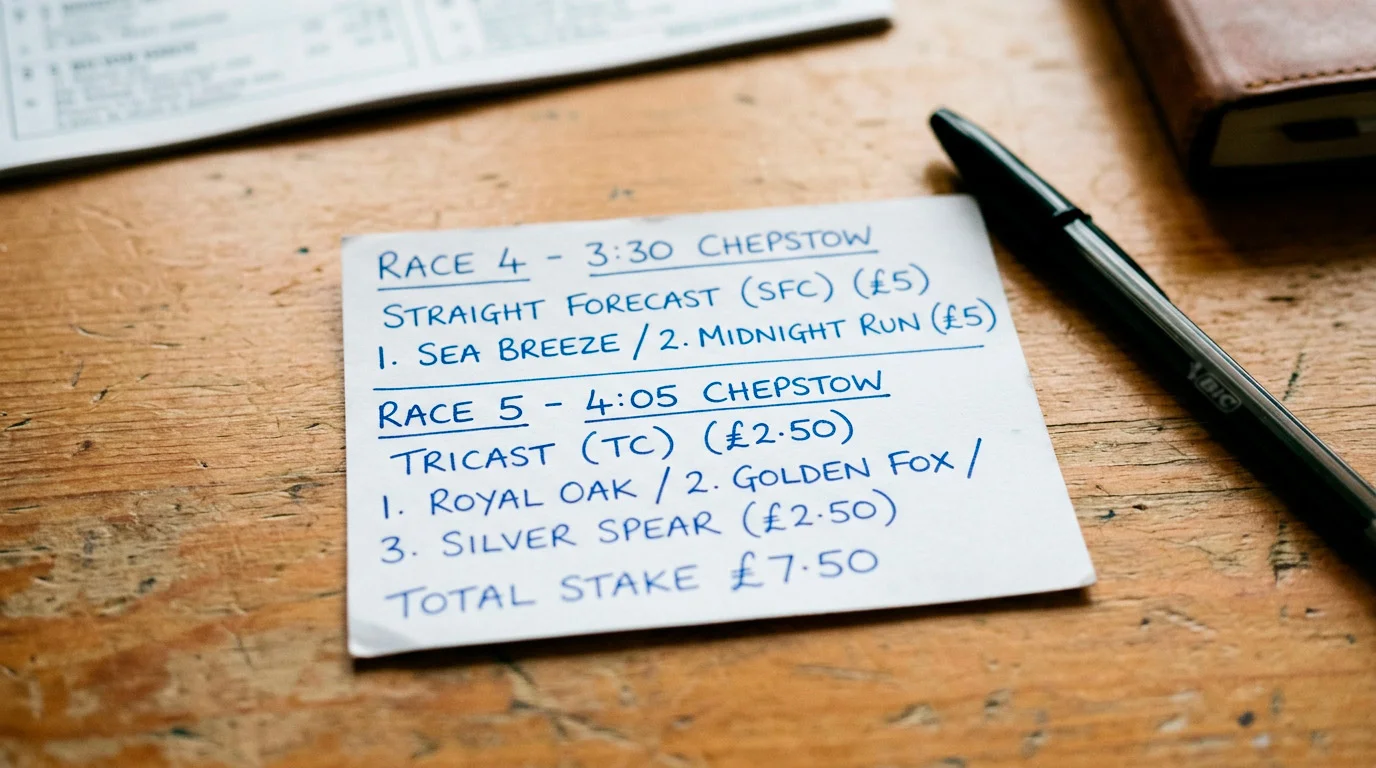
A forecast is a bet on the first two horses home in the correct order. A tricast is the first three in the correct order. The concept sounds more elaborate than it is: both are essentially multiples on finishing positions, and the returns are calculated by formulas that most punters never fully read. I have backed hundreds of forecasts over the years and I can tell you from experience that the bettors who win with them are the ones who understand the arithmetic. The ones who bet them on hunch and hope are the bookmaker’s favourite customers.
This piece walks through the two products – straight forecast, reverse forecast, Computer Straight Forecast and Tricast – with the maths that actually produces the dividend. If you have ever been handed a winning forecast slip and wondered why the return looked so different from what you expected, the answer is in the computation section below.
Straight vs reverse forecast
A straight forecast is a bet that two named horses will finish first and second in the exact order you specify. “Horse A to beat Horse B” is the standard wording. If Horse A wins and Horse B is second, the bet wins. If B wins and A is second, the bet loses.
A reverse forecast covers both orders. “Horse A and Horse B in either order” doubles the bet: you are effectively placing two straight forecasts, one each way around. A £2 reverse forecast costs £4 and wins on either outcome.
On markets where bookmakers offer priced forecasts, the prices are displayed directly and the bet pays at those prices regardless of the dividend calculation. On other races, forecasts are settled via the Computer Straight Forecast formula, which derives a dividend from the starting prices of the two horses finishing first and second. The distinction matters: a priced forecast gives you certainty about the return before the race; a CSF forecast gives you a dividend determined after the race by the SP formula.
Computer Straight Forecast maths
The CSF formula is simple in principle and messy in detail. The dividend is calculated from the decimal odds of the winning horse multiplied by a factor reflecting the second horse’s starting price and the total number of runners.
In practice, the formula approximates what two separate win bets at SP on the two horses would have produced if linked together, adjusted for an overround factor. A winner at 4-1 (decimal 5.0) with a second at 6-1 (decimal 7.0) in a 12-runner field typically produces a CSF dividend in the £20 to £35 per £1 stake range, depending on the specific field composition and the pricing of the other runners.
The factor that surprises newcomers is that CSF dividends are not simply the two win odds multiplied together. Two win bets at £1 each on 4-1 and 6-1 would return £5 and £7 respectively. The CSF dividend on the pairing is typically substantially higher because it compensates for the lower combined probability of picking both in the correct order. The formula builds in an assumed market overround, which is why a £1 CSF dividend on a 4-1/6-1 pairing is usually £25 or £30 rather than the £35 that pure odds multiplication would suggest.
The practical takeaway: if you want to know what a CSF forecast will pay before you bet, you cannot know exactly. You can estimate based on typical field sizes and price distributions, but the final dividend is calculated after the race using the formula and the actual SP of every runner. The uncertainty is part of the product.
Tricast computation
A Tricast is the same concept extended to three horses in finishing order. Select the first, second and third home in the correct order and the bet pays a computed dividend. Tricasts are available on races with a minimum number of runners (usually 8 or more) and on handicaps rather than non-handicaps in most cases.
Tricast dividends can be enormous. A winning Tricast on three mid-priced runners in a big field regularly pays £500 or £1,000 per £1 stake. Combinations of outsiders can produce dividends of £5,000 or more. The headline returns are why the product attracts casual stakes even though the strike rate is brutal – the probability of picking three specific horses in correct order from a 16-runner field is less than 1 in 3,300 before any consideration of individual horse form.
Perms make the product playable. Picking one horse as a “banker” for first and four other horses to fill second and third gives you 4 × 3 = 12 Tricast combinations at your unit stake. A 50p unit stake on 12 lines is £6, and if one of the combinations lands the dividend is paid in full on the winning line. The perm approach is how serious Tricast players operate; single-combination Tricasts are essentially lottery tickets.
Combination staking
Both forecasts and Tricasts can be perm’d – taking multiple horses for each finishing position and paying for every possible combination. The cost escalates fast. A forecast perm of three horses for first and three for second gives you 3 × 2 = 6 combinations (excluding same-horse pairings). A 50p unit stake costs £3. A Tricast perm of three horses for each position gives you 3 × 2 × 1 = 6 combinations if you do not specify finishing positions – or 3 × 3 × 3 = 27 with positions, minus same-horse combinations.
The structure of the perm matters. A banker-style perm (one horse fixed as winner, multiple alternatives for second and third) is cheaper and pays full dividend on the correct line. A scatter-style perm (multiple horses in every position) is more expensive but catches a wider range of outcomes. Most experienced forecast and Tricast players work on banker plus alternatives rather than pure scatter, because the banker discipline forces you to commit to one horse you genuinely think will win rather than spreading bets across three possible winners.
The 33% Flat-favourite strike rate tells you the baseline: if your banker is the favourite, you have a one-in-three chance the banker wins. Combined with a sensible three-horse perm for second and third, the strike rate on the full Tricast might reach 10% or 12% in a competitive race – still low, but meaningfully higher than a random pick.
When forecasts beat singles
The forecast market earns against singles in two specific scenarios. First, when you have identified a clear first and second but are unsure which finishes in front – a reverse forecast at CSF dividends usually pays more than backing both horses as two separate win singles at SP. Second, when a particular pairing of outsiders looks genuinely likely to fill the first two places and the market is underpricing that pairing – the CSF dividend on unlikely combinations is calculated generously and occasionally produces dividends that dwarf what the two horses’ win prices alone would suggest.
The second scenario is where real edge lives. In small-field Flat handicaps where one horse looks like a probable winner and one outsider looks like a likely second, a straight forecast on the pairing can produce a dividend three or four times what a win single on the winner would have paid. The bet is harder to land, but when it does the edge is substantial.
Second-favourite data is instructive here. The second-favourite strike rate of 19.4% across a large UK racing sample, with a level-stakes loss of 11.8%, means the second favourite is marginally overbet in straight win markets but priced much closer to fair in forecast markets where the full field is priced against it. A forecast with the favourite to beat the second favourite is a bet that often pays more than the two corresponding win bets combined.
The underlying interdependency between betting and racing, in the European Commission’s 2017 State Aid clearance document still cited by the BHA, is framed bluntly: “In the UK, racing and betting have a unique interdependency that goes back over 200 years. A day at the races includes, for most participants, betting on horse races as well.” That history produced the forecast and Tricast products as race-day fixtures long before online pricing existed, and the dividend formulas inherited from that era still produce occasional generous returns for punters who understand them. For the wider context of how forecasts sit within UK racing’s betting menu, the pillar on betting at horse racing covers the adjacent wagers.
Articles
Written by the editors at bettingathorseracing.com.
