

Five days that decide the Flat season
Royal Ascot is the Flat season’s equivalent of Cheltenham: five days in mid-June that concentrate a year of planning into 35 races. Unlike Cheltenham, Royal Ascot is also a state occasion, and the mix of international raiders, top-class turf specialists and summer handicappers produces a betting landscape unlike any other in the British year.
I have been through enough Royal Ascot weeks to know the rhythm: the first day is bookmaker-friendly, the middle days are where the Irish and French challengers show their hands, and Saturday’s punters are tired enough to bet sentimentally. Understanding the five-day arc shapes how I stake across the week.
Five-day shape
Royal Ascot runs Tuesday to Saturday. Each day has seven races. The programme rotates through the championship Group races and the Festival’s signature handicaps according to a structure that has evolved gradually over decades.
Tuesday opens with the Queen Anne Stakes over a straight mile, the Coventry Stakes for two-year-olds, and the King’s Stand Stakes over five furlongs. The opening day is designed to showcase top-class milers and sprinters and rarely produces surprises at the head of the market.
Wednesday is Gold Cup day historically, though recent scheduling has moved that showpiece to Thursday. The Prince of Wales’s Stakes over a mile and a quarter is Wednesday’s signature, featuring older middle-distance horses who define the summer Group 1 scene. Thursday features the Gold Cup itself – two and a half miles, the stayers’ championship – alongside the Norfolk Stakes for precocious two-year-old sprinters.
Friday is the day for specialists. The Commonwealth Cup for three-year-old sprinters, the Coronation Stakes for three-year-old fillies over a mile, and the Albany Stakes for juvenile fillies. Saturday closes the meeting with the Diamond Jubilee Stakes over six furlongs and the Wokingham Stakes, one of the most competitive sprint handicaps of the year.
Stands vs far side pace
The straight course at Ascot is a mile long and wide enough that fields split into two groups on soft or uneven ground. The stands-side and far-side dynamic is Royal Ascot’s defining pace question: which side of the course rides faster today, which side has more pace horses, which side will the better draws end up on.
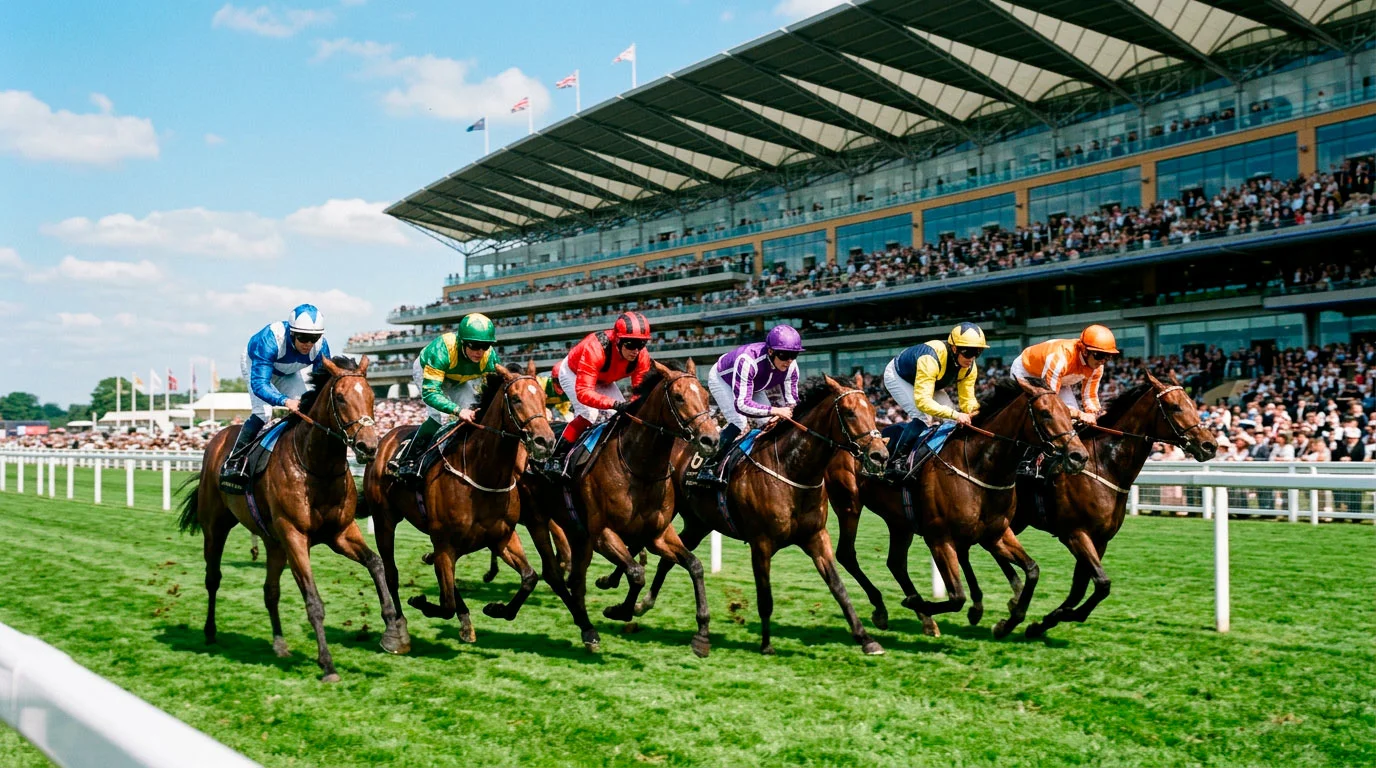
Historically the stands side has been the preferred side in big-field handicaps when the ground is fast, particularly on Tuesday and Wednesday cards before the turf has been chopped up. Once Thursday and Friday run, the going changes on different strips of the course and the bias can flip. Saturday’s Wokingham and Diamond Jubilee often produce famous photos of a stands-side pack and a far-side pack finishing in near-photo-finish order at the line.
The bias is not reliable enough to bet blind on. What it does is shape how you read the race: a horse drawn on the “wrong” side in a straight-course sprint is running a different race to the same horse drawn on the “right” side. Experienced Royal Ascot punters note the bias each day and weight their Saturday handicap selections accordingly.
Group One vs handicap betting
Royal Ascot splits neatly into two betting propositions. Group races – the 12 Group 1s, 2s and 3s across the week – are class events with relatively small fields and well-established form. Handicaps, by contrast, routinely field 20 to 30 runners with draw bias, pace questions and hidden form on horses who have not run at Festival level before.
The Group-race market is tight. Odds-on favourites turn up regularly – Baaeed, Frankel, Stradivarius and others have all been sent off at prices implying 70% or 80% win probability in their Royal Ascot appearances – and the 86% strike rate for horses priced at 1.25 or shorter in UK flat racing is a useful reference. Short-priced Group-race favourites win often enough to justify the price, but the margin for error is thin. One upset in a Royal Ascot Group 1 can erase a week of carefully staked odds-on backing.
The handicaps are where Royal Ascot’s real betting interest lives. With the UK fixture list at 1,460 meetings in 2025 and a long season’s worth of lower-grade handicappers feeding into Royal Ascot’s big sprint and mile handicaps, the form book is deep but inconsistent. Wokingham, Hunt Cup and Royal Hunt Cup fields routinely include horses well-handicapped on a couple of unseen runs the main market has not properly priced. Finding those horses is how the serious Royal Ascot players work.
International raiders
Royal Ascot has become genuinely international. The King’s Stand Stakes draws Australian and American sprinters. The Queen Anne pulls European milers. The Diamond Jubilee attracts Japanese and Hong Kong raiders in years when the schedule aligns. The international dimension adds a form-reading layer that pure domestic punters miss.
The challenge with international runners is that their form arrives in languages most British bookmakers price imperfectly. A Group 1-winning Australian sprinter turning up at Royal Ascot is priced against the domestic milestones most punters know – the Hong Kong sprint, the Japanese sprint champion – but the day-to-day Australian form the horse came through is not widely read in British markets. That gap between form knowledge and pricing is where value occasionally surfaces.
The 2025 attendance figures tell their own story about Royal Ascot’s commercial heft. Total UK racing attendance in 2025 reached 5.031 million, the first year over 5 million since 2019 and up 4.8% year-on-year. Royal Ascot is the single biggest contributor to that number; Royal Ascot Saturday alone can exceed 80,000 attendees. The week’s betting turnover scales accordingly, and the international liquidity in Royal Ascot markets is larger than any other British Flat week produces.
Royal Ascot economics
Royal Ascot’s prize money and commercial importance place it at the top of the British Flat calendar. The 2025 total prize money across British racing was £153 million, up from £148.3 million in 2024, with increases on both Flat (£3 million) and Jump (£1.7 million) segments. Royal Ascot alone accounts for a disproportionate share of Flat prize money, and the week’s Group 1 programme determines the following year’s stallion values at the top of the breeding market.
The political context around Royal Ascot has sharpened. Nick Timothy MP, co-chair of the All-Party Parliamentary Group for Racing and Bloodstock, warned in his 2025 APPG paper Securing Racing’s Future that “nobody will forgive ministers if their decisions lead to the decline of the nation’s second-biggest spectator sport.” Royal Ascot’s visibility – a state occasion watched globally – makes it the clearest illustration of what the APPG and BHA are defending when they argue against tax and regulatory measures they believe will drive the sport’s finances into deficit.
For punters, the economic context shapes the markets indirectly. Operators under margin pressure from tax reforms run tighter concessions during peak weeks; Royal Ascot’s Best Odds Guaranteed and extra-places programmes have been notably less generous in 2025 and 2026 than they were in 2022. That contraction in concessions is a Royal Ascot-specific shift the serious punter reads into the week’s stake sizing.
For the handicap mechanics and wider market dynamics that Royal Ascot’s biggest fields rely on, the pillar on betting at horse racing covers the context the five-day meeting sits within.
Articles
Published by the bettingathorseracing.com team.
