

Why a horse can run two entirely different races
Haydock, July 2020. The same horse I had backed to win a Newbury mile on fast ground three weeks earlier trailed in last at Haydock on soft. Same weight. Same jockey. Same trainer. The ground had gone from good-to-firm at Newbury to soft at Haydock, and the animal that had skipped over Newbury’s dry summer turf simply could not get through the Haydock mud. I had ignored the going change. The horse had not.
Going is the single most under-appreciated variable in UK racing betting. Form transfers perfectly between meetings only when the ground is the same. Change the ground and you have, in a real sense, changed the sport being played. Horses who love soft are different animals to horses who love firm, and a punter who does not factor going into every bet is routinely going to back horses running on the wrong surface.
The official going scale
The British going scale runs in seven steps. Hard is the driest – essentially baked turf, rare in the UK because racecourses usually water to avoid it. Firm is the next step, still dry, used on the hottest days of summer on turf courses that have not been heavily watered. Good-to-firm is what you want to see on a sunny June afternoon: dry, fast, uniform. Good is the middle of the scale and the most common reading across the British season. Good-to-soft indicates a little give in the ground, typically after overnight rain. Soft is properly wet turf where horses’ hooves mark the surface. Heavy is the extreme: waterlogged, slow, deeply sapping.
Between those seven official terms, the clerk of the course adds modifiers. “Soft, heavy in places” means the uniform reading is soft but pockets of the course are worse. “Good, good-to-firm in places” suggests fast ground with only the driest strips faster than average. These hedges matter: a “soft, heavy in places” card probably rides closer to heavy than to good-to-soft, because the heavy patches usually fall across the finishing straight.
National Hunt courses use the same scale. Jumps racing through the British winter routinely encounters soft and heavy ground, because the season runs exactly through the wettest months. Cheltenham in March has produced every reading from good-to-firm to heavy within a single Festival in different years, and the horses who prosper shift accordingly.
Going stick and watering
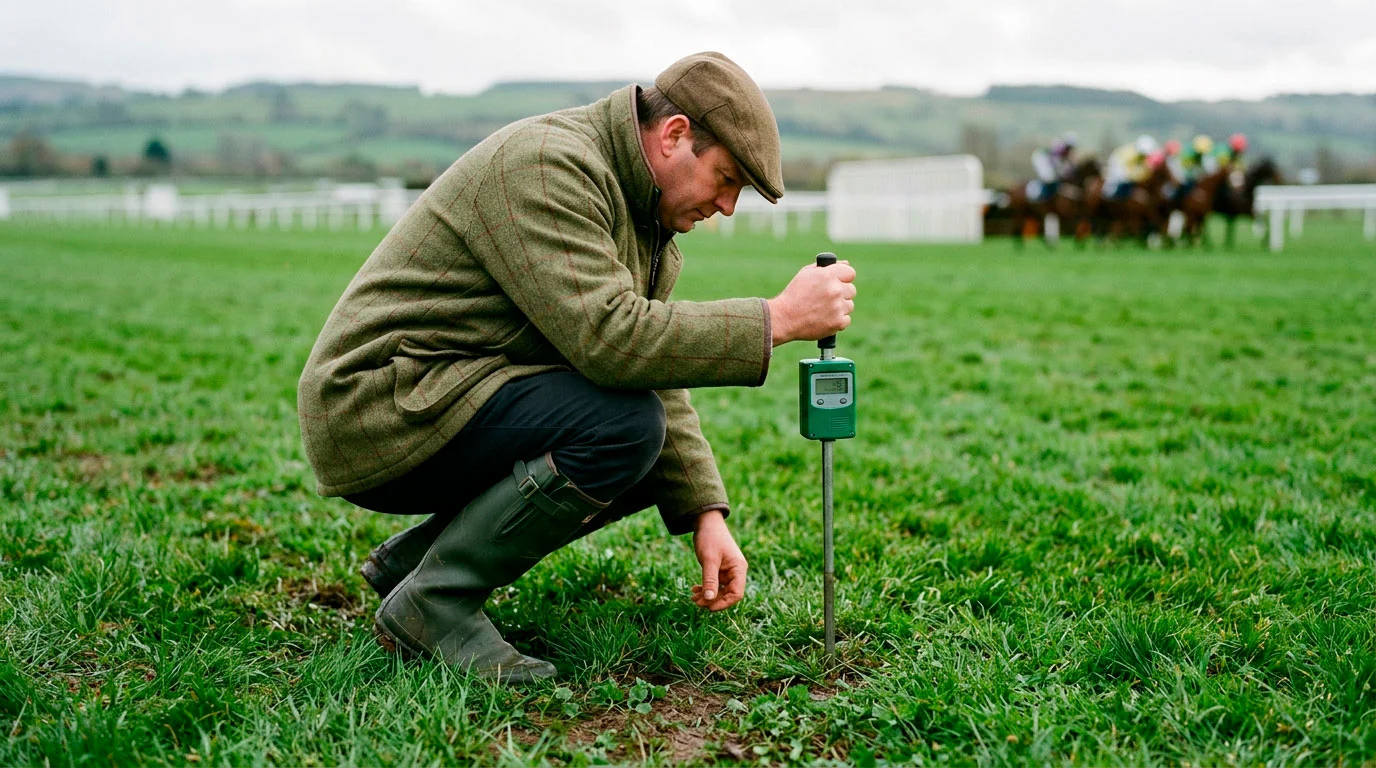
The going stick is the instrument clerks of the course use to measure ground penetration and shear. It is essentially a spiked probe pushed into the turf at multiple points around the course, producing a reading between 0 (deepest, slowest) and 15 (firmest, fastest). A reading around 6 corresponds to soft, 7-8 to good-to-soft, 8-9 to good, 9-10 to good-to-firm, 10-plus to firm.
Readings are taken and published in the morning of racing and sometimes updated during the card. They are not the whole picture – a course can have a going stick reading that says “good” while one strip of the track rides softer than another – but they are the best objective measure available, and they are published in the racecard on most serious platforms.
Watering policy is where the clerk shapes the reading. Most courses water in summer to keep ground from going firm, because firm ground produces injuries and owners refuse to run their horses on it. The decision of how much to water, which strips to water, and how close to racing to finish watering is a judgement call that affects the racing line, the draw bias and the final going reading. A clerk who waters heavily across the whole course produces uniform good-to-soft; one who waters selectively produces variable ground that reshapes the race.
Horses that need cut
Some horses simply do not move on fast ground. Their action is too high, their feet too heavy, their stride too rolling. Put them on good-to-firm and they feel every step; put them on soft and they flow through it. These are “cut-in-the-ground horses” in racing parlance – horses that need some give underfoot to perform.
The signal is in the form. A horse whose best runs have all come on soft or heavy is telling you something specific. When the same horse runs on good-to-firm and finishes tenth, that is not a collapse in form – it is a ground issue. When it reappears on soft and wins, the form line resumes. Punters who do not read going conditions attached to form figures routinely write off horses as “declining” when they are in fact perfectly fine animals running on wrong ground.
Trainers know their horses’ going preferences and run them accordingly, but they cannot wait forever for perfect ground. A cut-loving horse running on fast ground is usually there because the yard has target races coming up and needs to keep the horse race-fit; do not read too much into such runs. The bet comes later when the same horse reappears on ground that suits. With the British fixture list running 1,460 meetings in 2025 and roughly a third of those falling in the wet winter months, the opportunities to catch soft-ground horses at the right moment are plentiful for punters who track them.
Firm ground specialists
The opposite camp is the firm-ground horse, usually a lightly built, fast-actioned sprinter or miler whose mechanics suit a springy, dry surface. These horses bounce off good-to-firm and flounder in the wet. Their strike rate on firm ground can be two or three times their strike rate on soft. They tend to appear at the major summer meetings – Royal Ascot, Goodwood, York’s Ebor meeting – because that is when the ground is most likely to suit them.
Spotting a firm-ground horse is a matter of reading the going reading alongside the form figures. A horse with three wins all on good-to-firm and four defeats all on good or softer has revealed its preference. Running that horse in a Saturday handicap on soft ground is a declaration of intent rather than a realistic win bid; lay rather than back it if the market has not adjusted.
Attendance trends point to the commercial reality behind all this. The 2025 UK racing gate of 5.031 million – the first over 5 million since 2019, up 4.8% year-on-year – concentrates on summer Flat meetings where firm-ground horses dominate the big races. The sample of top-class turf racing on fast ground is meaningful enough in any one season to spot specialists emerging.
Late going changes and bets
Overnight rain is the punter’s nightmare. You placed your ante-post selections yesterday on the assumption of good ground; by 9am the clerk has downgraded to good-to-soft; by 1pm you are looking at soft; by racing at 3pm the final reading is “soft, heavy in places.” Every horse in your bet is now running on ground different to the one you priced.
The practical response depends on the bet. An ante-post wager struck with Non-Runner No Bet protection behaves one way if your horse is withdrawn due to ground; without NRNB your stake is lost. A race-day wager cannot be voided, but if the ground has shifted radically from morning to post time, a running-rail move or a jockey change may also have happened – both worth monitoring.
The pattern to watch for in 2025 and into 2026: the number of high-quality Flat runners has held steady at 1,423 rated 90-plus in 2025 against 1,398 in 2024, but within that pool the going preferences have diverged. More genuine soft-ground specialists emerged through 2025’s wet spring, and the summer’s good-to-firm specialists concentrated their wins into a tighter window. Punters who read the going changes in real time and adjusted their stakes came out better than those who stuck to ante-post selections regardless. For the bigger picture on how going factors into pricing across the calendar, the pillar on betting at horse racing is the anchor.
Articles
Published by the bettingathorseracing.com team.
