

The Chester stall that cost me a month’s profit
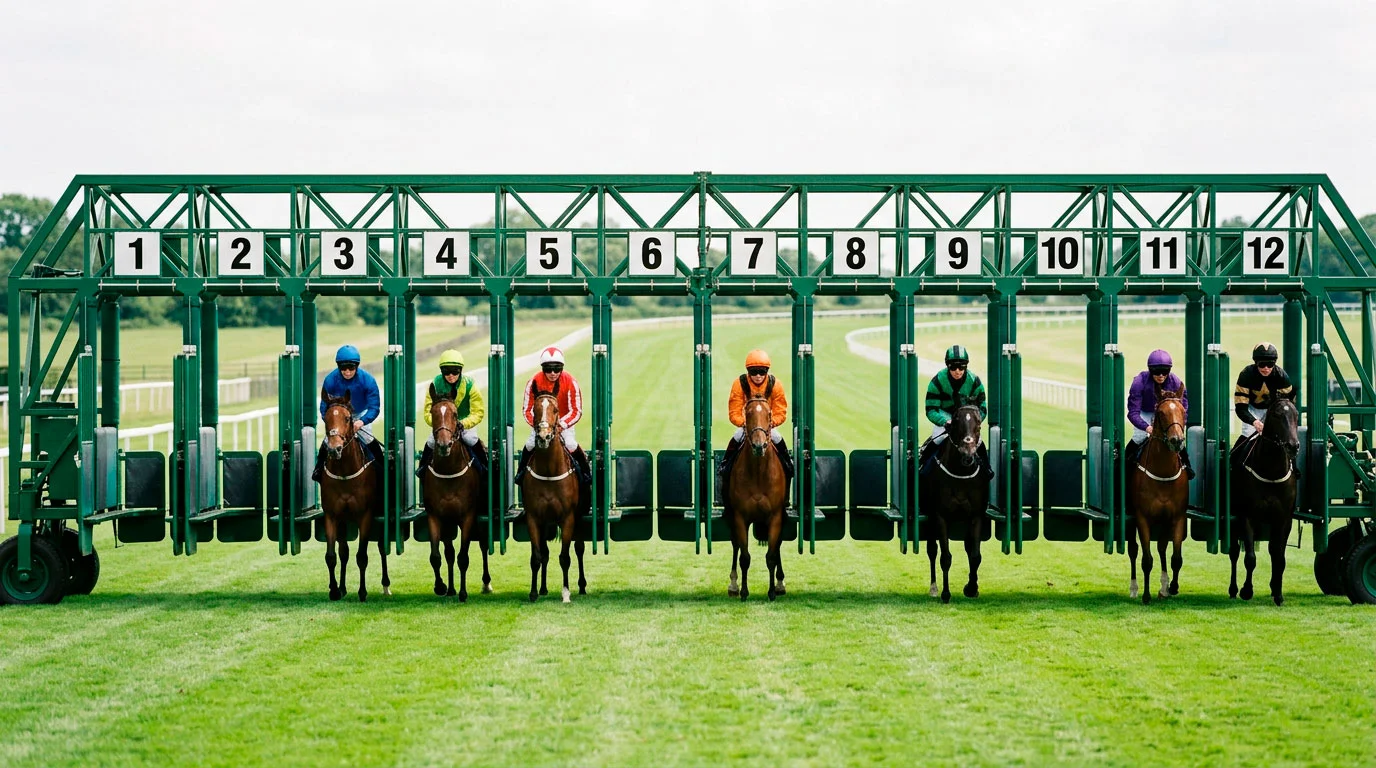
Chester, May 2018. A five-furlong sprint, ten runners, my horse drawn in stall nine. I had watched the form, backed the class angle, and ignored the one thing everyone around the rail had been telling me for an hour: do not back a high draw at Chester. The horse finished sixth. The 12-1 outsider drawn in stall one won going away. I went home having learned a lesson the form book cannot teach you.
Draw bias is the structural edge a starting stall gives a horse before the race has even begun. On some British Flat courses it is the single most important factor in the race. On others it is noise. Telling the difference between the two is what separates punters who understand the geography of British racing from punters who do not.
What creates a draw bias
Draw bias exists because racecourses are not symmetrical. A track with a sharp bend early in the race favours horses on the inside of that bend, because the inside horse runs a shorter path to the finish. A track with a rise, a fall, or a camber in the ground produces running conditions that favour certain stalls over others. A track that has been watered unevenly produces an even faster bias still.
Three specific features produce most of the bias in UK racing. The first is the run to the first bend: short runs favour the inside, long runs let the field sort itself out before the turn. The second is the camber or gradient of the course: Chester’s tight, banked turns favour low draws; Newmarket’s straight-course gradient sometimes favours one side of the track depending on wind and ground. The third is the pace of the race itself: a field with three or four front-runners drawn high will drag the racing line wide and produce a bias that would not exist in the same race with the same horses differently drawn.
The key word is structural. A bias shows up only when the same pattern repeats across hundreds of races run under similar conditions. One race’s finish does not prove a bias; a hundred races’ finishes might. Serious draw analysis works from sample sizes of three seasons or more, because one wet summer can invert the picture at an entire track.
Sprint vs mile bias
Sprints are where draw bias shows up most sharply. Five and six-furlong races are often won or lost in the first two furlongs as the field sorts itself out; a horse dragged wide in those opening moments is running a longer race than a horse drawn rail-side. On courses like Chester, Goodwood and Beverley, five-furlong sprints can swing the price of an otherwise equivalent horse by 20 to 30% based on stall draw alone.
At a mile the picture changes. The field has more time to organise, jockeys have more room to work, and a slightly wider draw matters less because the tactical options expand. On a fair mile course – Newmarket’s Rowley Mile, Ascot’s straight mile, York’s straight mile – the draw can still be worth a length at most fields, but not the two or three lengths it can be worth in a Chester sprint.
Middle-distance Flat races over a mile and a half or further almost always neutralise any draw bias that existed at the start. Any handicap over that trip is decided by stamina and pace judgement, not the quarter-second gained coming out of the stalls. If you see a tipster blaming a draw for a beaten favourite at 12 furlongs, ignore them.
Course by course notes
Chester is the extreme case. The Roodee is a tight, almost circular left-handed course with a sharp early bend, and low draws dominate across all distances under ten furlongs. In big-field Chester sprints the difference between stall one and stall twelve can be two or three lengths at the line.
Beverley five-furlong sprints run up a straight course that is cambered towards the stands side. High draws – closest to the stands rail – have historically dominated the results, particularly on faster ground. The pattern is strong enough that draw charts at Beverley are printed with explicit strike-rate numbers for each stall.
Goodwood’s five-furlong course bends sharply into the straight and favours low draws strongly in big fields. The pattern weakens at six furlongs and effectively disappears at seven. Ripon’s six-furlong straight runs slightly against the camber and occasionally favours centre-high draws; the pattern is less consistent than Chester’s.
At Ascot the picture is complex. The straight course favours stands-side draws when the ground is fast and the field is large, but this pattern has been inconsistent enough that no-one prices it at high confidence. Royal Ascot cards are studied obsessively and the draw biases shift year to year depending on watering policy and wind direction.
On the flat midweek cards at Kempton, Lingfield and Wolverhampton, draw bias is mostly mild. All-weather surfaces are engineered to run truly, and while small biases exist – inside or outside at certain distances on certain courses – they are not strong enough to override form at anything but the most marginal level. With the UK fixture list at 1,460 meetings in 2025, the majority of runnings are on courses where draw simply does not shift the price materially.
Going and draw interaction
Draw bias is not static. It moves with the ground, the wind, the watering and the pace of the meeting. A low-draw bias at Chester that has held for decades can flip on a soft-ground day if the rail-side strip has been raced over for three consecutive cards. A stands-side bias at Beverley that looks bulletproof on fast ground can vanish when the ground goes heavy and the far side of the track suddenly rides better.
Ground changes are the most reliable source of bias shift. On heavy ground at right-handed courses, the outside of the track often rides faster because it has been walked on less, and horses drawn wide benefit. The opposite applies on fast ground where the inside rail is freshly prepared and runs quickest.
With 2025 attendance at UK racing reaching 5.031 million – the first year above 5 million since 2019, up 4.8% on 2024 – the volume of races run over the same strips of turf is substantial. Repeated use compacts ground and rewards whichever line of the track has been raced over least. Experienced draw analysts read the going-stick reading and the position of running rails against the meeting’s previous two or three days before setting their draw chart for the day.
Pace bias vs draw bias
Pace bias is the first cousin of draw bias and frequently mistaken for it. A pace bias exists when the way the race is run – rather than the geometry of the course – favours horses in certain positions. A field with no front-runner produces a slow early pace, which usually favours horses that can quicken off the back; a field with three or four horses that always go forward produces a scorching early pace that collapses at the finish, favouring closers.
The distinction matters because a pace bias is transient; it exists only for the specific race in front of you, not for the course in general. If four of the twelve runners in today’s Ascot handicap are known front-runners, the pace is going to be brutal and the closers are going to be advantaged. That is a read you make from the form of the specific runners, not from the course in general.
I try to separate the two questions. First, does this course have a structural draw bias at this distance? Second, does the specific field today produce a pace that will help or hurt certain draws? A good draw on a biased course can still be beaten by a terrible pace scenario. A mediocre draw on a fair course can be compensated by a perfectly suited pace.
Brant Dunshea, speaking for the British Horseracing Authority during the 2025 debate around racing’s economic pressures, said racing is “the second most-attended sport, we employ people nationwide but also we are already facing other financial threats around the levy and affordability checks.” The commercial stakes around every fixture have climbed as the sport’s regulatory environment has tightened, and the consequence for punters is that every structural edge – draw bias included – is worth the work of understanding. For the wider pricing context, the pillar on betting at horse racing sets out the market mechanics draw bias feeds into.
Putting draw analysis to use
My working rule is that draw bias only overrides form at about six UK courses and only at certain distances. Chester five and six furlongs. Beverley five furlongs. Goodwood five furlongs. Ripon six furlongs on certain strips. Brighton sprints depending on the camber. A few others occasionally. Everywhere else, draw is a small factor worth noting but not a factor worth acting on.
On those six courses, though, the effect is big enough to reshape a card. I will dismiss a well-backed favourite drawn badly at Chester and consider an outsider drawn well that the market has ignored. I will factor draw into my stake size on a sprint handicap at Beverley. I will treat draw with scepticism everywhere else, because if I gave it the weight I give it at Chester at courses where the effect is marginal, I would be fitting a pattern to noise and losing money doing it.
Articles
Written by the editors at bettingathorseracing.com.
